You have the license, a few clients coming in from a directory, and a weekend blocked off to finally build the website, and the part that stalls you isn't the writing or the photos. It's the platform. Squarespace, WordPress, Wix, Weebly, or one of the companies that only builds sites for therapists, and every roundup you read says something different about which one is best for private practice therapists. As a therapist who also runs a marketing agency for clinicians, I have built and rebuilt therapy websites on nearly every platform on this list, and I am going to walk you through what each one is actually like to live with after launch, which one I recommend for a solo or small practice, and the two things no platform will do for you.
Key Takeaways
I recommend Squarespace for a solo or small therapy practice because you can build it yourself, the SEO settings you need are built in, and you can edit it after launch without paying someone.
WordPress is the stronger choice only if you have real technical skills or a developer you plan to keep paying, because the maintenance is yours.
A therapist-specific website company can get you launched quickly, and before you sign, you want to read who owns the copy and the domain if you ever leave.
No website builder makes your practice HIPAA-compliant on its own, so clinical information stays inside your EHR portal and off your contact form.
The platform matters less than whether the words on the site speak to the one type of client you most want to work with, and that part is yours no matter what you build on.
Why does the platform you choose matter for a therapy website?
The platform determines how much time the website takes after it is live, whether Google can read it properly, and how hard it is to change your fee, add a specialty, or swap a photo a year from now. A site you can't update yourself tends to sit untouched, and an untouched site tells a potential client you might not be taking new people.
It is not uncommon for therapists in Private Practice to reach out to me after someone has already built their site. The design works, the copy is decent, and the fee on the services page is two raises old because changing it means emailing a developer, waiting, and remembering to follow up, and that never feels urgent until a new client mentions the old number on a consult call. The website is never going to win against a full day of clients for your attention, so the platform you choose has to let you fix one number yourself in the five minutes you have between sessions, without pulling up a tutorial to do it.
The second piece is search. Your ideal client is looking for you on Google and, increasingly, by asking Siri or ChatGPT to find a therapist who understands what she is going through. The platform has to let you set a page title, write a meta description, add alt text to images, and submit your site to Google so it gets read in the first place. Every platform below can do that, but some make it a setting and others make it a plugin you maintain.
Which website platform is best for private practice therapists?
Squarespace is the best website platform for a solo or small private practice because it is easy to build and edit yourself, includes hosting and security, and has built-in on-page SEO settings. WordPress is more flexible and belongs on the list, but only when you have the technical skills or a developer to maintain it.
1. Squarespace
Best for: a therapist who wants a professional site she can build and update herself, with the SEO basics handled inside the platform.
I build on Squarespace for my own clients, and it's the best platform for therapists, clinicians, and other mental health professionals who want more control and autonomy when making updates and edits to their website.
The editor is drag-and-drop, the templates already look like a service provider's site instead of a store, and hosting, security, and the SSL certificate are part of the subscription, so there is nothing to renew separately. The SEO settings you need are where you expect them to be, so you can set a page title, write a meta description, and add alt text without installing anything. If a client wants to raise her fee or add a page for a new specialty a year after launch, she can do it herself in an afternoon.
The limitations are real, and I would rather you know them before you commit. Squarespace is a subscription platform, so you pay a monthly fee as long as the site is live, and you can't export the design to another system, so if you ever move to WordPress, you'll rebuild the site rather than move it. Third-party integrations are also more limited than WordPress, although every scheduling tool I see therapists use has either an embed code or a booking link that works on a Squarespace page.
If you want the fastest route to a site that looks finished, I offer Squarespace templates built for therapists.
2. WordPress.org
Best for: a therapist who is comfortable with technology and web design, or a practice with a website developer on retainer that needs something a drag-and-drop builder can't do.
WordPress ranks first on nearly every list of website platforms, and I put it second on purpose. It is open source so that you can change almost anything, and its plugin library covers booking tools, payment processors, membership areas, and SEO plugins like Yoast or Rank Math that give you more control over how each page appears in search. A group practice that needs a custom intake flow or a clinician who plans to add a course someday has room to grow here that Squarespace doesn't offer.
That flexibility comes with maintenance, and you handle it. You buy hosting separately, you run the updates to WordPress itself and to every plugin, you keep backups, and you handle security, because an out-of-date plugin is how a therapy site ends up hacked. Plugins also conflict with each other, and troubleshooting that on a Tuesday night between clients is not a good use of your evening. If you already know you don't want to be the person who logs in to run updates, that is reason enough to choose Squarespace instead, and if you have a developer you trust and plan to keep paying, WordPress is a solid long-term platform.
3. Wix
Best for: a therapist who enjoys moving things around herself and wants a built-in booking tool.
Wix gives you more creative freedom in the editor than Squarespace, and its plans are affordable and include hosting. The built-in booking system is the real draw for a solo practice, because a client can request a consult time directly on the site without a separate tool. The template library is large, and if you like adjusting your own layout, you will probably enjoy working in it.
Two things to know going in. Once you pick a template, switching to a different one later means rebuilding your pages, so choose carefully at the start. The SEO tools have improved a lot over the last few years and are fine for a solo practice, but they still don't give you the control WordPress does, and I find the editor's freedom can turn into a cluttered page unless you keep yourself to a simple layout.
4. Weebly
Best for: the therapist who needs something online by Friday and has very little to spend on it.
Weebly gets you a site faster and cheaper than anything else on this list, and for a practice that isn't earning much yet, that can be reason enough. Setup takes an afternoon; the page title and description fields are there, and a five-page site with a contact form will work. What you give up is the look. The templates haven't kept up with Squarespace or Wix, there isn't much you can move around on a page, and the tools you can plug in are thin. If money is the reason the site still isn't live, build on Weebly now and move the copy over to Squarespace once the practice can carry the subscription, which is what I would tell a friend in that spot.
5. Therapist-specific website companies
Best for: a therapist who wants someone else to handle the whole site and the ongoing marketing, and is comfortable with a monthly fee for that.
Companies like TherapySites exist because building a website feels like one more thing standing between you and seeing clients. They do get you launched quickly with templates made for therapists and marketing support included in the plan. For a clinician who wants to hand it all off and never think about it again, that is appealing.
Before you sign a contract with anyone, read the agreement for two things to make sure you are protected if you ever move your site to a different platform or choose to manage it yourself later, even if you think you'll want the site handled for you.
One is what the monthly plan adds up to over a few years, because a number that bundles design and support looks small next to a one-time build and usually isn't once you multiply it out. Squarespace charges a yearly hosting fee of $250-400, but if you pay $100 a month for hosting, that is $1200 a year. That's a big expense for a therapist who may not need monthly website updates and isn't receiving any SEO support.
The other is what happens to the site if you leave. Some of these companies keep ownership of the copy they wrote for you, and if they bought your domain on your behalf, some charge to transfer it, so choosing to move to a different platform can mean starting over with completely new website copy, a new website design, and a new domain, at the same time you are trying to grow.
Always get both answers in writing before you decide. The one question I would ask is: Do I own the assets, copy, design, and domain for the website you are building for me?
From The Passive Practice, a done-for-you Squarespace option
Your website is built on Squarespace, with the strategy and the writing handled for you.
I build every website on Squarespace because it is the platform I recommend to therapists over anything else. It is easy to edit yourself, doesn't require a developer to maintain, and handles SEO well when built correctly from the start. The Passive Practice does the research, the copy, the branding, the graphics, the design, and the SEO that build the site for you, and then you own it and can edit it yourself without an ongoing website management contract.
This fits a therapist who wants the strategy and the writing handled by someone who understands her ideal client, and who wants to be able to go in and change a sentence or add a page herself once the site is live.
What every website package includes, no matter which one you choose.
I start every project with the same four things, and we build the website on top of them once they are done.
The onboarding excavation. Before I write anything, you fill out onboarding forms that go into how you talk about your work, the words you naturally use, and the clients you love working with. If writing is hard for you, you can send me voice memos instead so I can hear how you actually sound. Therapists tell me the excavation takes longer than they expected, and they also tell me it's the work they need to do because it asks you to get clear on who you are as a clinician before anyone touches your site.
The ideal client research. From your excavation, I research the person you want to reach, based on how she describes what she is going through online rather than her clinical version. I look at the questions she asks, the words she uses to describe her experience, and where she is in her search when she lands on a therapist's website. You receive this as an ideal client profile, and it is what your homepage speaks to.
The brand voice guide. Your forms and the research become a brand voice guide that documents how your practice sounds, what you say and do not say, and how you talk to your ideal client. This is what keeps your website, your Google Business Profile, your blogs, and anything you write later sounding like the same person, and it is yours to use long after the site is done.
The keyword research. I research what your ideal client actually types into Google and asks AI when she looks for help, and I build your keyword strategy from that instead of from a list of specialties and a city. You receive it as a keyword tracker, and those keywords are written into your copy, your page structure, and your Google Business Profile so Google can understand who your site is for and show it to the right person.
Why I build it this way: a website written in clinical language and set up without research can look beautiful and still bring in no one, because the person searching for you isn't using the words on your pages, and Google has nothing specific to rank. When the voice, the research, and the keywords come first, the copy sounds like you and speaks to the specific client you want more of, and the structure underneath it gives Google something specific to rank so she can find it. Every package includes these four pieces because everything else builds on them, and the packages differ only in how much design and how many pages are built on top.
Best for: a therapist who wants expert help now and control of the site later.
Includes: research into the one experience your favorite clients share, keyword research, original website copy in your voice, branding, custom graphics, a responsive Squarespace design, on-page SEO setup, and handoff support.
Account: the site is built in or transferred to your own Squarespace account at launch, and you receive the logo files, brand guide, graphics, and copy.
Ongoing obligation: your Squarespace subscription. There is no required retainer with The Passive Practice to keep the site running.
Limitation: Squarespace stays a subscription platform, and the finished design is not portable to another content management system.
How the four paths compare
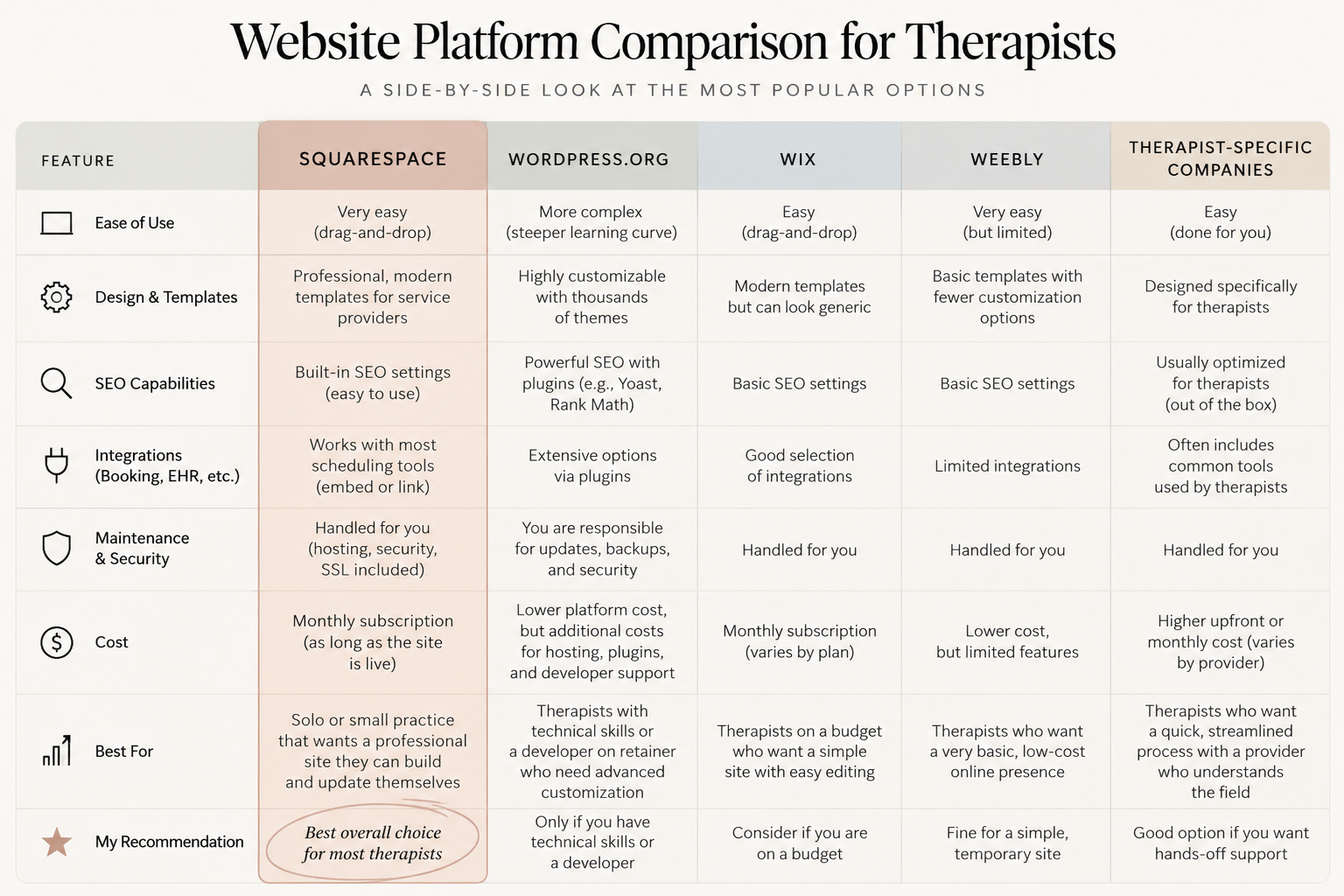
What features does a private practice therapist's website need?
A private practice website needs editable page titles and meta descriptions, a mobile layout that works on a phone, a contact form that asks only for basic information, a clear way to request a consult, a blog you will actually use, and a connection to Google Search Console so the site gets read. Everything beyond that is a nice-to-have.
Here is what I check on every platform before I recommend it to a therapist.
You can edit the page title, SEO meta description, and image alt text on every page yourself.
The site looks right on a phone without a separate mobile version, because that is where your ideal client is reading it.
The contact form collects a name, email, phone number, and a short line about what she is looking for, nothing clinical.
There is a way to book or request a consult, whether that is a built-in tool, an embedded scheduler, or a link to your EHR's client portal.
A blog is included because a new post every two weeks on a different circumstance of your ideal client is how a small site starts ranking.
You can connect Google Search Console and submit a sitemap, because if Google hasn't read the site, nobody is finding it.
The monthly cost still makes sense whether the practice is full in a year or not.
Do you need a HIPAA-compliant website builder for a therapy practice?
No website builder makes your practice HIPAA-compliant on its own, and a marketing website shouldn't hold any protected health information in the first place. The platform you build the public site on and the system you use for intake paperwork, scheduling, and client messages are two different things, and keeping them separate is what protects you.
Your website's job is to help the right client decide you are the therapist for her and reach out. The contact form should ask for her name, how to reach her, and a line about what brought her to your site, and then your reply and everything after it lives inside your EHR's client portal, which was built to handle that information. SimplePractice, TherapyNotes, and the other platforms therapists already pay for give you a secure intake link you can put on the contact page, and that solves the problem on any website builder in this article.
If a platform advertises HIPAA-compliant hosting, read what it actually covers before it becomes the reason you choose it. A business associate agreement for hosting doesn't change what a visitor types into a form or where that form delivers, and I wouldn't choose a harder platform to use for protection the site doesn't need.
What should go on the site once you pick a platform?
Once you choose a platform, the site works when the homepage speaks to the experience your favorite clients share, each page includes your city and the kind of therapy you offer in the words your client would use, and every page has a clear next step. The design holds her attention for a few seconds, and the copy is what keeps her reading.
Start with the one type of client you love working with and write the homepage to the experience those clients have in common, which is usually something like the shame of not being able to fix it themselves or the exhaustion of being the one who holds everything together. A basic site is five pages, so this is not the stage for a specialty page per client type, and you can add those when you are ready to invest. For research, type her situation into Answer the Public and read Reddit threads where people sound like her, because a full strategy needs far more than that, but it will get your first draft out of clinical language.
Then make sure your Google Business Profile matches your site, because when your ideal client is looking for a therapist, Google reads your profile, your maps listing, and your website together. Submit the site to Google Search Console or nothing on it gets read. After that, write a new blog post every two weeks about a different circumstance your ideal client is in, in the words she would type, and let the site build from there.
Frequently Asked Questions about Websites for Therapists in Private Practice.
What platform do therapists use for their website?
Therapists mainly use Squarespace, WordPress, Wix, and therapist-specific services like TherapySites. Squarespace is the most common choice for a solo practice because you can build and edit it without technical help; WordPress shows up in group practices with a developer, and therapist-only companies serve clinicians who want the whole site managed for a monthly fee.
Which website builder is best for therapists?
Squarespace is the best website builder for a solo or small therapy practice because it is easy to edit yourself, includes hosting and security, and has built-in on-page SEO settings. WordPress is a better fit only if you have the technical skills or a developer to maintain it, because you're responsible for updates, backups, and security.
What are some good websites for private practice therapists?
A good private practice website says in the first few lines who you help and what they are going through, in their words rather than clinical language, and then makes it easy to reach you. It loads quickly on a phone, each page names your city and the kind of therapy you offer, and the contact page gives a clear way to request a consult without asking for clinical details.
Do therapists need a HIPAA-compliant website?
A therapist's marketing website doesn't need to be HIPAA-compliant because it shouldn't collect protected health information. Keep the contact form to a name, contact details, and a short note, and move intake forms, scheduling, and client messages into your EHR's client portal, which is built to handle that information securely.
The platform you pick this weekend is not the decision you're stuck with
If the fear of choosing wrong is what has kept the site unbuilt for months, pick Squarespace, start with a template, and get your five pages up. The site can grow with the practice, the copy can be rewritten as you get clearer on who you love working with, and nothing about that first version is permanent except the fact that your ideal client can finally find you.
If you would rather talk it through before you commit to anything, I offer a free consult call where we spend about ten minutes finding the one experience your favorite clients share and the rest of the time on what your site actually needs to do for your practice. And if you already have a site and want to know why it isn't bringing in calls, the free SEO audit gives you a personalized report with feedback you can act on yourself, without the technical jargon.
Let me know if you have any questions,
Amanda