When you started your private practice, doing your own marketing made sense. You built the website on a template, wrote the Psychology Today profile yourself, set up the Google Business Profile, and learned what potential patients responded to by watching what happened.
Now the caseload is fuller, the website has needed an update since spring, the blog lives in a folder of half-written drafts, and the only time marketing happens is a Sunday night after the last note is done, which is usually when you open the laptop, stare at the homepage, and close it again.
Deciding when to outsource your private practice marketing is a capacity decision rather than a judgment on whether you can do the work, and as a therapist who runs a marketing agency and has talked more than one prospect out of hiring me, here is how I make that call with the clinicians who ask me on a consult call.
Key Takeaways
· Doing your own marketing makes sense when the practice is new, the positioning is still changing, the budget is tight, and you have the hours, because the learning is worth more than the money saved.
· Outsourcing makes sense when you know what needs to happen and the work keeps not happening, because the owner has become the point where every marketing project stops.
· Outsource the specialist work closest to the business goal first, usually the website and the search visibility, and keep the decisions that depend on your clinical judgment.
· Set a marketing budget from your growth goal, realistic client value, and what the practice can afford. No single percentage works for every practice.
· Hire someone who can explain why each piece of work exists, who leaves you owning your accounts, and who will recommend a smaller step when it makes more sense.
How do you decide if outsourcing marketing will benefit a private practice?
Outsourcing marketing benefits a private practice when the owner knows what the marketing needs to do, the practice earns enough to pay for the work without strain, and the hours the owner would spend on marketing are worth more in sessions, leadership, or rest. Doing the marketing yourself benefits the practice while the positioning is still changing and the budget is limited.
The way I think about this starts with the value of your time, because therapists trade time for income more directly than most business owners. If you collect $150 a session and spend eight hours a week on marketing, those eight hours represent up to $1,200 in possible session revenue if they could actually be filled, and that is before the hours you spend thinking about the marketing you are not doing. That is an opportunity-cost illustration, not a promise that all eight hours would turn into paid sessions. It does not mean outsourcing is automatically cheaper. The agency invoice shows up on a statement every month and the owner's hours never show up anywhere, so the comparison has to count both.
Doing your own marketing can be the right choice when you are early in private practice, when you have the hours and genuinely do not mind the work, when you offer a small number of services, and most of all when who you want to work with is still changing, because paying someone to build on a positioning that will move in six months wastes the money.
My DIY path for a new practice is five pages that speak to the one type of client you love most, a Google Business Profile that matches the website, submitting the site to Google Search Console so Google reads it, and a useful blog at a cadence you can realistically maintain on a different circumstance of your ideal client, and that path teaches you what potential patients respond to before you pay anyone to build on it. My therapy practice marketing guide lays that out in order.
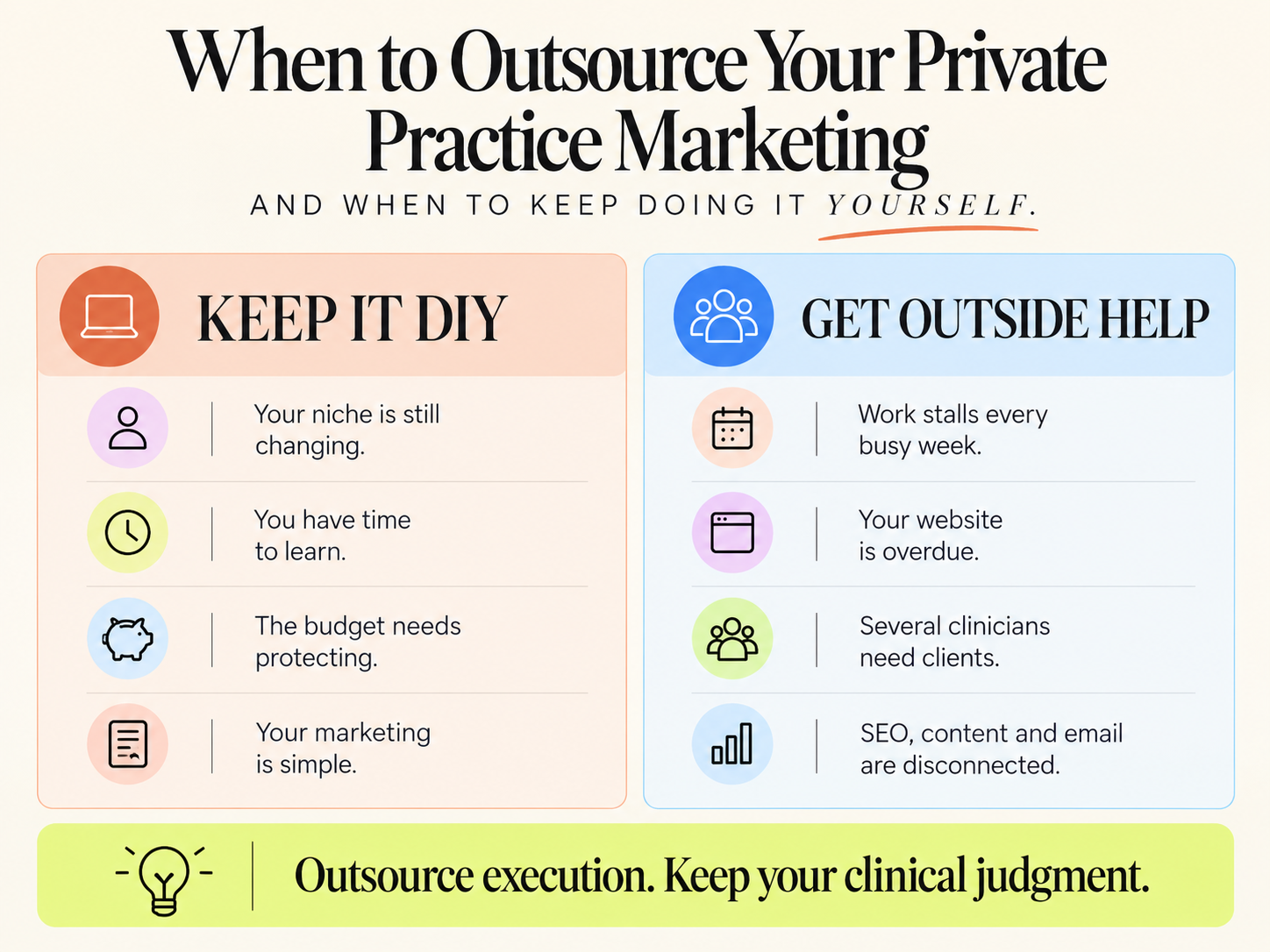
When DIY marketing makes sense and when outsourcing is the better fit.
What are the key indicators it is time to hire a marketing firm for a private practice?
The key indicators that it is time to hire a marketing firm are that marketing disappears whenever the caseload is busy, the website has needed updates for months, the practice has clinicians whose caseloads need filling, the SEO, website, email, and social work are disconnected, and every marketing decision waits on the owner. At that point the problem is capacity rather than knowledge.
There is usually a moment where the problem stops being that you do not know what to do. You know the website needs a specialty page for the couples work, you know the Google Business Profile has one photo and no services listed, and you know the email list has not heard from you since the workshop in March. The work keeps not happening because you are the only person who can do it and you are also seeing twenty-four clients this week.
The most common pattern I see when I do FREE Website & SEO audits for practice owners who are thinking about hiring help is a practice that has grown past the website, with two or three clinicians added to a site built for one, a services page that lists everything in a paragraph, and inquiries that still ask for the founder by name.
The owner on those calls understands marketing fine and has run out of hours to do any of it. That is the clearest sign it is time to outsource, because a practice where growth plans keep moving because nobody owns the execution has a bottleneck, and the bottleneck is the owner's calendar. If you want to see where your practice sits before deciding, get in touch to ask about a website and SEO review.
Which marketing services should a private practice consider outsourcing first?
A private practice should outsource first whatever sits closest to the business goal and furthest from the owner's clinical judgment, which is usually the website and search visibility, then blog writing, email setup, and reporting. The decisions about who the practice serves, what the practice charges, and how the clinical work is described stay with the owner.
Start with the bottleneck rather than with the platform someone said you need. If the website gets almost no search visibility, seven social posts a week will not fix what is restricting growth. If the website gets traffic and nobody reaches out, another twenty blogs are not first either, because the problem is on the pages people already see.
If inquiries are healthy and follow-up is inconsistent, the problem sits in the email or consultation process. Say the goal is filling two new clinicians. Then the questions are how people currently find the practice, where qualified inquiries come from and where they drop off, whether enough people know those clinicians exist, whether the website explains their specialties, and whether Google can find those pages. That tells you far more than which platform is popular this month.
The rule I give clients is to keep the decisions that depend on clinical and business judgment and outsource the work that requires specialist skill, consistent production, or both. Specialist skill means keyword research, SEO implementation, website build, analytics setup, and design. Consistent production means the blog, the email, and the Google Business Profile posts that have to go out every two weeks whether or not the caseload is heavy.
What never gets outsourced is who you want to serve, your scope of practice, your ethics, your fees, your capacity, and final approval on anything that describes clinical work, because a marketer can translate your clinical work into language a potential patient understands and should not invent your clinical identity for you.
What are the advantages of outsourcing private practice marketing versus doing it in-house?
Outsourcing private practice marketing to a specialist gives the practice strategy and execution from one team without hiring and managing an employee, while in-house marketing gives the practice a dedicated person who works alongside the team every week and creates employer obligations. A freelancer sits between the two and fits one defined project.
DIY, freelancer, agency, or in-house
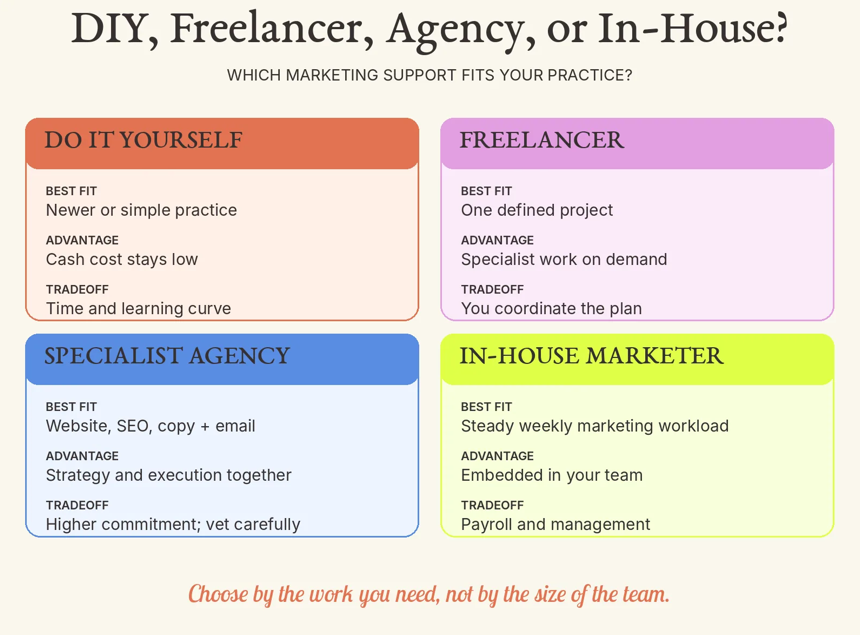
A freelancer is a good fit when you know exactly what you need, like two SEO blogs a month or a redesign of three service pages, and you are willing to be the one deciding what happens next and making sure the project fits the rest of the business. An agency makes more sense when the pieces depend on each other, which is most of the time once a practice is past five pages. The SEO depends on new specialty pages, the pages need copy, the copy has to match the brand, the site needs the update, the new traffic needs a clear consultation path, and the email list should support the same offer. You can hire one person for each of those five things, and then you are the marketing director coordinating all five.
An in-house marketer makes sense when a group practice has enough steady work to fill the role. I am not a lawyer or a tax professional, so have your arrangement reviewed by someone who is. For federal tax purposes, the IRS looks at the actual relationship, including behavioral control, financial control, and the type of relationship. Calling someone a contractor in an agreement does not make them one. Compare the role you need, not just an agency invoice against a salary.
How much does it cost to outsource marketing for a private practice?
The cost of outsourcing marketing for a private practice depends on the scope, with a one-time website or SEO setup priced as a project and ongoing SEO or content priced monthly, but there is no universal percentage of revenue every therapy practice should spend. The right number for your practice comes from what a new client is worth and what the practice is trying to change.
The SBA recommends building a marketing plan around the target market, the sales goals, an action plan, a budget, and measurement, and comparing marketing costs with the revenue those efforts produce in its marketing plan guidance. For a therapy practice, the useful reference point is what a client is worth.
Average collected session fee times the expected number of sessions gives you an approximate client value, so a $150 session over twelve sessions is about $1,800, and a clinician's full caseload is that number multiplied across the caseload. The client value calculation does not predict what any one client will spend, and the number gives you something to hold the marketing budget against, because if you have no idea what a new client or a full clinician is worth, judging whether a marketing proposal is reasonable gets much harder.
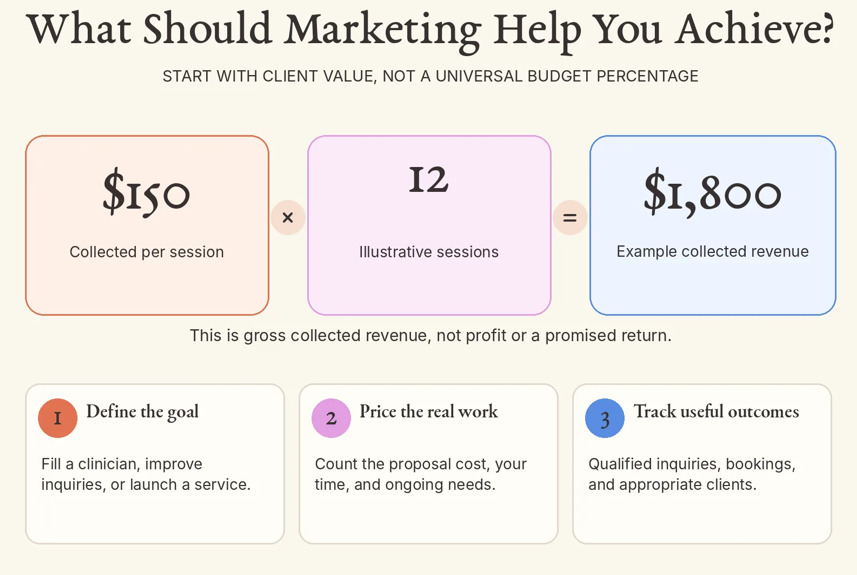
A simple client-value example can help put a marketing budget in context.
You may have seen percentage-of-revenue marketing rules in practice-management articles. I would treat those as prompts for planning, not a standard every private practice has to meet. A full solo therapist with a waitlist and no desire to grow has a different business case from a group practice trying to fill six clinicians, and a psychiatrist launching a second location has a different case from either.
Start with the goal, know what a new client may be worth, count your own time, and decide what the practice can comfortably carry. If the budget cannot support ongoing help, start with a smaller project. You do not get extra business-owner points for buying the biggest package available.
Is it worth it to hire a marketing agency for a therapy practice?
Hiring a marketing agency is worth it for a therapy practice when the agency's work produces qualified inquiries the practice can serve, at a cost that makes sense against what those clients are worth, and when the owner gets meaningful hours back. Judge each channel by what that channel can influence, and judge the whole engagement by inquiries and bookings rather than by follower counts.
A lot of the therapists I talk to have already paid someone and gotten nothing, and the distrust is earned. The pattern I hear is a package that was identical for every practice, reporting that never explained what the work was for, and copy that could have belonged to any therapist in the city. I joined a marketing program once with a colleague and we both left, because the funnel existed before anyone had learned who she was or who her ideal client was, and that experience is most of why I build the way I do now.
Every project I take starts with three things before a page gets designed, a brand voice that sounds like the clinician, an ideal client profile built from research into the person she most wants to work with, and keyword research so that person can find her, and the website, the blogs, and the profiles get built on top of those. That is also why I say no to a project when the three foundations are not there yet.
Measure the engagement on three levels. Visibility metrics like search impressions, clicks, and profile views tell you whether the work is being found, and they are useful without being the finish line. Inquiry metrics are what I care about for a private practice, meaning consultation requests, calls, contact forms, booking actions, and which service produced each one, and Google Analytics can mark those actions as key events so you can see which channel sent the person who booked using Google Analytics key events.
Business metrics are the ones to ask about after a few months, meaning whether more appropriate clients are booking, whether clinician caseloads are changing, whether revenue is moving in the intended direction, and whether the practice can serve the demand being created. A dashboard can look beautiful while your intake coordinator keeps saying these are not the people we are trying to reach, and no report can make that a success.
How do you find a reputable marketing agency that specializes in healthcare private practices?
Find a reputable marketing agency for a healthcare private practice by asking who the agency usually works with, which work the team does directly, what the first ninety days look like, which accounts you will own, what gets reported, what the contract includes and what costs extra, and why the agency is recommending this specific scope. The answer to the last question tells you most of what you need.
A few things should make you ask more questions. Anyone guaranteeing a number one position on Google is promising something Google says outside providers cannot know, because Google warns that no one can guarantee a number-one ranking. Reporting you cannot understand is a problem, because you do not need to approve every font size and you should always be able to say what your marketing partner is working on and why.
An agency that controls your accounts is the one I would walk away from fastest. Google requires businesses to retain ownership or co-ownership of the Business Profile when working with a third party and requires the third party to return control when the relationship ends under its third-party Business Profile policies, and the same standard applies to your domain, your website, Google Analytics, Search Console, your email list, your ad accounts, and your creative files.
Outsourcing the work never includes handing over the accounts the business runs on. A proposal with twenty blogs, thirty posts, and eight emails and no explanation of what each piece is for is a list of deliverables with no plan behind them, and a list of deliverables does not fill a caseload.
Healthcare marketing carries one more layer. The FTC requires advertising claims to be truthful, not deceptive, and supported by evidence under its advertising guidance, so be careful with any marketer who makes the practice sound impressive through outcome claims, treatment claims, or comparisons with other providers you would not say directly to a client.
The marketing team may write the page, and your professional obligations still belong to the practice, so everything gets reviewed against the rules tied to your license, your state, and your clinical services. This is the reason working with people who already understand practitioner businesses saves so much explaining, because you should not have to teach a marketing team why therapy marketing cannot copy the playbook written for a gym or a skincare brand.
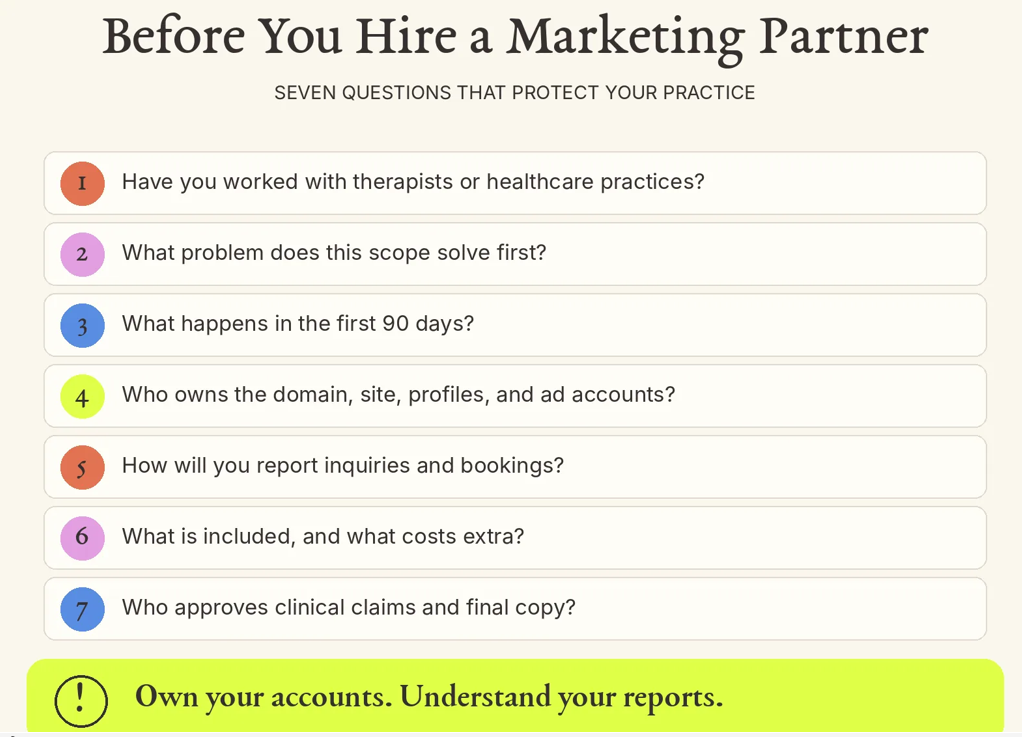
Use these questions before signing with a marketing partner.
What outsourcing looks like at The Passive Practice, and when I tell someone not to hire me
The work at The Passive Practice is scoped to the problem the practice actually has rather than sold as one package, which is why I have told more than one prospect on a consult call that a smaller step made more sense than what she came to buy. The consult call starts with about ten minutes finding the one experience your two or three favorite clients share, and the rest of the call is figuring out what needs to come off your plate and what does not.
If the main problem is search visibility, start with an SEO project. My SEO & Content Strategy services currently include SEO Audit & Strategy, SEO Aligned, and SEO Aligned Plus, so the scope can match what is actually missing. If the practice has outgrown its website, my website and brand services address copy, structure, design, and SEO. If the caseload leaves you no hours for ongoing content, email, and search work, my marketing retainers connect strategy to execution. And if you need to talk through one decision before hiring anyone, contact me to discuss the right starting point. You do not need four different marketing vendors unless the business actually needs them.
If you need one person to edit four videos a month, hire a video editor. If you are still figuring out who you want to work with and what you want the business to become, you are not ready to hand a large scope to anyone, including me, and the DIY path above is the right place to be. Buy the amount of support the practice is actually ready to use.
Outsourcing should remove the bottleneck rather than create a new job
If you hire marketing support and still spend your week assigning every task, inventing every idea, fixing every deliverable, and chasing five contractors, the marketing never left your plate and you added project management to it. Good outsourcing keeps you informed about your own business, and the work no longer depends on you opening Canva at 9:47 at night after the last note is finished. Marketing exists to support the clinical business you built, and the moment marketing becomes another job you created for yourself, the arrangement has stopped working. If marketing has become the work you know needs to happen and no longer have the hours to carry, contact us and we can figure out what should come off your plate first.
Let me know if you have any questions,
Amanda
Frequently Asked Questions
Is it worth it to hire a marketing agency?
Hiring a marketing agency is worth it when the practice earns enough to fund the work, the owner's hours are worth more in sessions or leadership than in marketing tasks, and the agency can explain what each piece of work is for and show results in qualified inquiries. A practice that is still deciding who it serves usually gets more from a smaller step first.
How much does it cost to outsource marketing?
Outsourcing marketing for a private practice is priced as a one-time project for a website or SEO setup or as a monthly fee for ongoing SEO, content, and email work, and the exact cost depends on scope and the competitiveness of the market. A responsible budget depends on your growth goal, likely client value, available cash, and how you will measure qualified inquiries.
What are the advantages and disadvantages of outsourcing?
The advantages of outsourcing private practice marketing are specialist skill, consistent production, and hours returned to the owner. The disadvantages are the cost, the need to vet the provider carefully, the risk of generic copy that does not sound like the clinician, and the possibility of losing control of accounts if the agreement does not state that the practice owns them.
What are some risks of outsourcing?
The main risks of outsourcing private practice marketing are a provider who controls your domain, website, or Google Business Profile, marketing claims that overstate outcomes or credentials, a one-size package that ignores the practice's real problem, and reporting too vague to tell whether the work produces inquiries. Each is avoidable by asking the right questions before signing.
Should I hire a freelancer or a marketing agency?
Hire a freelancer when you need one defined specialty or project and are willing to manage the strategy yourself. Hire an agency when several pieces, like website, SEO, copy, and email, have to work together and you do not want to coordinate each specialist. Choose based on the problem the practice has rather than on which option sounds more established.
About the author
Amanda Smith, MA, MFT & CEO of The Passive Practice. Amanda is a therapist in private practice who built The Passive Practice, a brand strategy and marketing agency for therapists, psychiatric nurse practitioners, physicians, and group practices. Every project starts with three things, a brand voice that sounds like the clinician, an ideal client profile built from real research, and keyword research so the right client can find her, with the website built on top of those. She keeps a caseload on purpose because it keeps her useful to the therapists she works with.