When you started your private practice, you set up a Google Business Profile because someone said every therapist needs one, you added your hours and a photo of the waiting room, and then you went back to seeing clients.
Now a potential patient in your city types "trauma therapist near me" into Google, and three directories and two practices across town show up, but your practice doesn't appear on the map, even though your office is four blocks from where she is standing.
Local SEO for therapists means making sure Google understands where you practice, what you treat, and why someone nearby should see your name. But most of the advice out there was written for dentists and plumbers who can collect 200 Google reviews. A therapist cannot, and should not, so the strategy has to be built differently.
Key Takeaways
· Google ranks local results on relevance, distance, and prominence, and for a therapist two of those three are limited by ethics and geography, so the strategy wins on relevance and on reputation that does not come from client reviews.
· A Google Business Profile generally requires eligible in-person contact, so telehealth-only therapists build the plan around specialty pages and statewide pages instead.
· A dedicated page for each specialty, written in the potential patient's words with the city named, is the strongest local organic ranking factor a therapist controls.
· The APA, ACA, and NASW ethics codes limit therapists from soliciting client reviews, so the reputation layer comes from directories, professional organizations, local media, and referral partners.
· Directories own the broad "therapist near me" search, so the practice goes after the specific searches a directory profile cannot answer.
What is local SEO for therapists and how does it work?
Local SEO for therapists is making a private practice visible when someone near the office searches for a therapist by location, like "anxiety therapist near me" or "EMDR therapist in Torrance."
Local SEO works through two systems: the Google Maps results tied to the Google Business Profile and the regular website results underneath them, and a practice can rank in one without the other.
The difference between SEO and local SEO is the location. General SEO helps the private practice website rank for a question or a specialty regardless of where the searcher is.
Local SEO adds the place, which means Google is matching the searcher's location against the practice's address, the categories and services on the Google Business Profile, and what the website says about where the practice is and what the practice treats.
The map results depend heavily on the Google Business Profile and on how far the searcher is from the office. The organic results underneath depend on the website.
That split matters because a lot of therapists treat local SEO as Google Business Profile maintenance, editing the hours every few weeks and wondering why nothing changes. The profile is one of several sources
Google reads, and the private practice website, the specialty pages, the directories, and the links from other sites all tell Google the same story or a conflicting one, and local SEO is the work of making them agree. If you need the full picture of how search works for a practice, my guide to SEO for therapists covers that first.
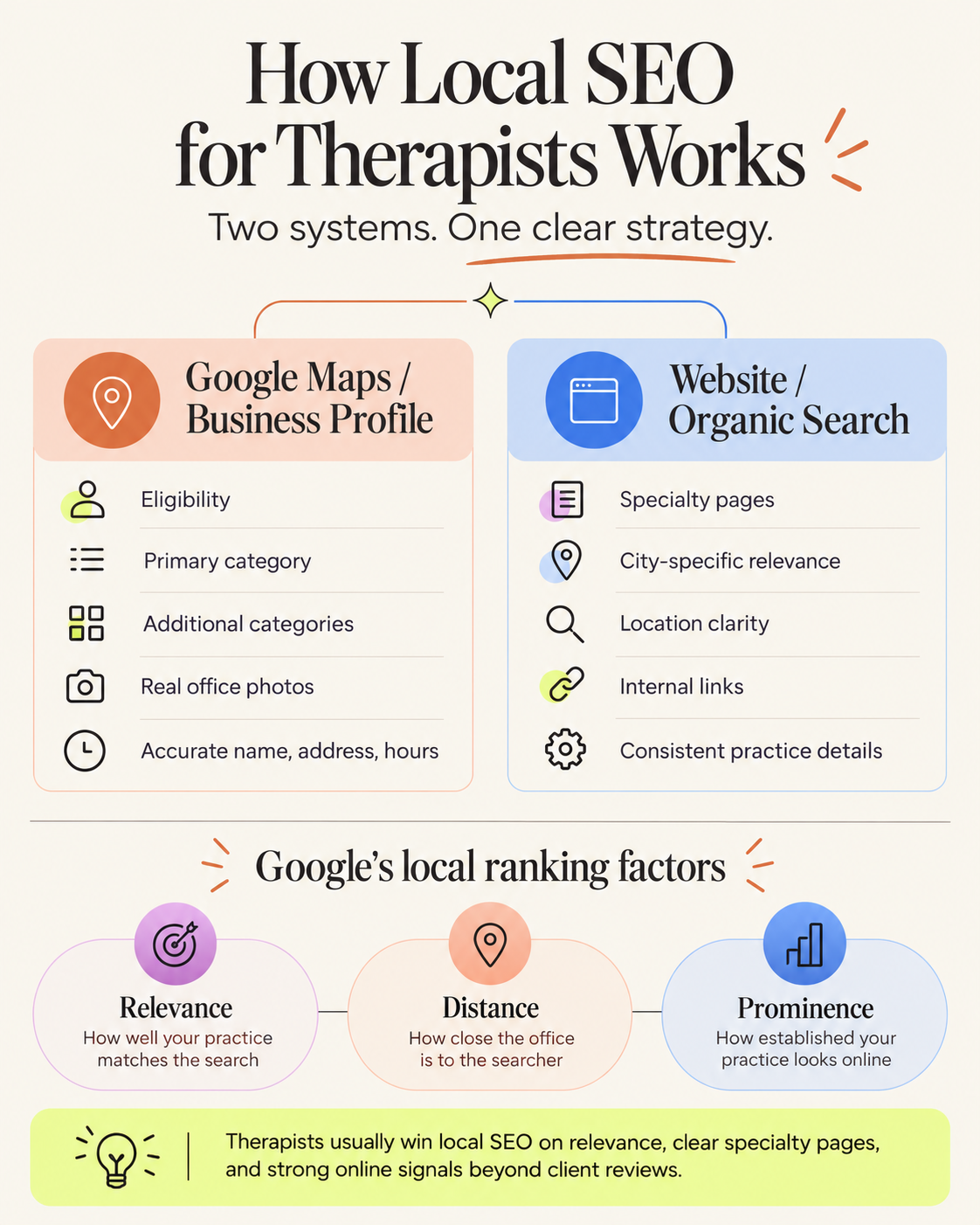
How local SEO works: Google Maps and website search rely on different signals.
What are the three main factors in Google local rankings?
Google says local results are ranked mainly on relevance, distance, and prominence. Relevance is how well the practice matches what the person searched, distance is how far the office is from the searcher, and prominence is how well known and established the practice looks online, which Google measures partly through links, review count, and ratings.
Relevance is the factor a therapist controls most, and relevance is built on information. If you want to appear for "OCD therapist in Denver," Google needs enough accurate detail across the Google Business Profile and the website to understand that the practice treats OCD and sees clients in Denver.
Writing "OCD therapist Denver" fifteen times on the homepage gives Google nothing to work with. A page about OCD therapy that answers what the potential patient in Denver is asking, including what treatment looks like, whether sessions are in person, and how to get started, gives Google exactly what relevance means, as long as the primary category on the profile matches the service.
Distance is the factor you cannot optimize away. Google uses the searcher's location, so a therapist across town can rank above you for one searcher because that office is closer, while someone five miles away sees a different set of results. This is also why searching your own keyword from your own phone and deciding you rank number three tells you very little.
Google's own Search Console guidance says position varies by location and search history and recommends watching trends in clicks and impressions rather than a single position number.
Prominence is where the advice for therapists goes wrong, because Google says more reviews and positive ratings help local ranking, and the ethics codes that govern a clinician limit how reviews can be requested. A therapist builds prominence through the places the practice is already mentioned, meaning professional directories, association listings, referral partners, local organizations, and press, and I cover how below.
Why is local SEO for therapists different from local SEO for a dentist or a plumber?
Local SEO for therapists is different because therapists are limited in collecting the reviews that drive prominence; directories like Psychology Today occupy the first screen for "therapist near me," many practices work from a home office or provide telehealth where a Google Business Profile may be restricted or unavailable. A therapist's real market under telehealth is the whole licensed state rather than a few miles around an office.
Reviews come first because the numbers are stark. In study of 16,098 Google Business Profiles, profiles with 201 to 500 reviews reached the top three Maps results 73 percent of the time, against 39 percent for profiles with one to five reviews.
A therapist bound by APA Standard 5.05, ACA Standard C.3.b, or the NASW code cannot solicit testimonials from clients, so a therapist competing on review count against a med spa or a chiropractor usually ends up ranked below them. The same study found that a fully complete profile, ten or more real photos, and using every relevant additional category each made a measurable difference in top-three rates, and none of those depend on asking a client for anything, so those are the factors to work on.
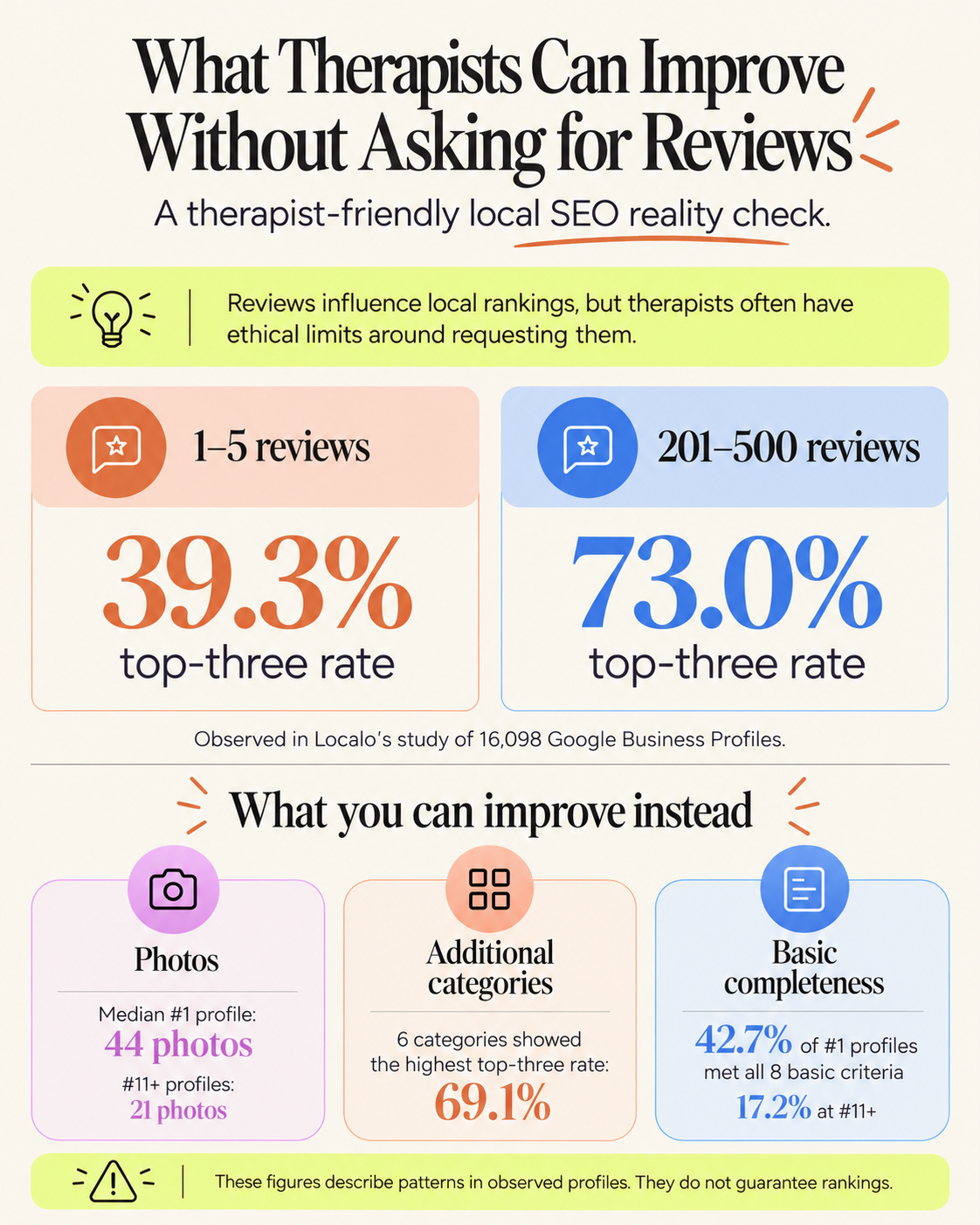
Data Source: Localo, analysis of 16,098 Google Business Profiles. The findings show correlations, not guaranteed results.
Directories come second. When a potential patient searches "therapist near me," Psychology Today, GoodTherapy, Zocdoc, Alma, and Headway take the first screen, with BetterHelp and Talkspace ads around them. Competing with a directory for a broad search wastes a solo practice's time. The better move is the specific search a directory profile cannot answer well, like a treatment method plus the city, the specific experience the potential patient is having plus the city, or an insurance plan plus the suburb, and then treating the directories as places to be listed and cited rather than as competitors.
Telehealth comes third. The map reaches people within a few miles of the office, and telehealth reaches everyone in the states where you are licensed, so a local SEO plan built only around city pages misses most of the people a practice can actually serve.
Group practices have one more factor available. Google allows a profile for the practice plus a separate profile for each public-facing clinician, as long as the clinician profile uses the clinician's own name rather than the practice name. Each clinician profile is another chance to show up in a nearby map search, and a solo clinician practicing under a brand name gets one shared profile in the "Brand: Name" format.
How can therapists improve their local SEO rankings with the Google Business Profile?
A therapist improves local rankings on the Google Business Profile by confirming the practice is eligible, choosing the primary category that matches the license and main service, adding every relevant additional category and service, filling the profile completely, adding real photos of the office, keeping the name and address accurate, and connecting the profile to a website page that supports the same information.
Eligibility comes before everything else. Google requires in-person contact with customers during stated business hours to qualify for a profile and lists online-only businesses as ineligible. A practice with a physical office where you see clients qualifies, a hybrid practice qualifies, and a telehealth-only practice does not. Creating a listing at a rented mailbox or a virtual office so you can appear on the map is not a workaround, because Google says a rented mailing address where the business does not operate is ineligible, and a coworking space only qualifies with signage and staff present during business hours. Google suspends listings built on an address the practice never worked from, which leaves you with no listing and a profile history Google remembers.
The home office question comes up on almost every audit I do for solo therapists. If you see clients in person at your home, do not assume you can set up a service-area profile and hide the address. Google defines service-area businesses as those that travel to customers, not offices where clients visit. The question is whether the home office qualifies under Google's location guidelines, and whether listing it creates a privacy concern. For the home-office therapists I work with, privacy usually wins.
The primary category is the single most important map ranking factor. Pick the one that matches your license and your main service, Psychotherapist, Marriage Counselor, Psychologist, or Mental Health Clinic, rather than the most popular one, and then add every additional category that fits.
Do not add keywords to the business name. Google's guidelines say the profile name must reflect the real-world name; unnecessary information can get the profile suspended, and data shows keywords in the name have far less impact than experts assume. If you are naming a new practice and want the specialty in the name, that is a branding decision made before the profile exists, and not a profile edit.
Photos and completeness are the two factors that cost nothing and that most therapist profiles skip. The most common mistakes I see when I do FREE Website & SEO audits are a profile with one exterior photo, no services listed, a single category, and a website link that goes to a homepage that never names the city. Ten or more real photos of the office, the waiting room, and the building entrance, a full services list, and a link to the page that actually matches the profile's category fix most of what those audits turn up. If you want my full click-by-click setup, the free GMB Starter Kit covers it.
How do you optimize a therapy website for local SEO?
To optimize a therapy website for local SEO, build a dedicated page for each specialty that names the city and answers what the potential patient searching that specialty wants to know, create location pages only where the practice has a real office or a real difference by location, link the specialty pages, location pages, and clinician pages to each other, and keep the practice name, address, and phone number identical everywhere online.
A dedicated page for each service is the number one local organic ranking factor, and city or neighborhood relevance on that page is number two.
A general services page that lists anxiety, depression, trauma, and couples in one paragraph gives Google almost nothing to rank. A page about teen anxiety therapy in Torrance that opens on what the parent searching is actually worried about, explains how you work with teens, says the office is in Torrance, and sessions are in person or by video, and ends with how to book is a page Google can match to that search.
This is where my work differs from a generic local SEO checklist, because the specialty page gets written from research into the words the potential patient uses, like "my teenager won't talk to me anymore," rather than from the clinical category, and that is what makes the page relevant to the search and readable to the person.
Location pages are different from specialty pages, and the two get confused. A separate location page makes sense when you have more than one physical office, different clinicians at different locations, or services that differ by office. Thirty pages that are the same text with Dallas, Plano, Fort Worth, and every suburb swapped in are not a strategy, and Google's spam policies call that doorway abuse. For a hybrid practice, the office page covers the city and the statewide specialty pages cover the license footprint.
Internal links build the picture Google reads. A blog post about panic attacks links to the anxiety therapy page, the anxiety therapy page links to the location page, and the location page links to the clinicians who treat anxiety there, so a person can move from information to service to provider without hunting, and Google can see how the pages connect.
Google's SEO Starter Guide recommends exactly that kind of logical organization and crawlable linking. Keep the name, address, and phone number consistent across the website, the Google Business Profile, Psychology Today, and the other directories, and the referral organization profiles, because Google pulls business information from all of them, and an old suite number on a directory you forgot about creates doubt. You do not need to submit the practice to 437 directories, only to clean up the ones that matter.
Do reviews affect local SEO for therapists, and are therapists allowed to ask for Google reviews?
Reviews affect local SEO for therapists because Google says review count and positive ratings help local ranking, and therapists are limited in asking for them. APA Standard 5.05 says psychologists do not solicit testimonials from current clients or people vulnerable to undue influence; ACA Standard C.3.b extends that to former clients, and the NASW code says the same for social workers.
That means a checklist telling every therapist to email every client for a five-star review does not apply to you, and the therapists I talk to who feel uneasy about that advice are right to. Google's own rules add a layer, because Google prohibits paying for reviews, discouraging negative ones, selectively asking only happy customers, or pressuring anyone toward a particular rating.
What a therapist can do is make leaving a review possible without soliciting one, which means the profile exists, the review link is available on the website for someone who chooses to look for it, and nothing in the intake or exit process asks for it. Check the code attached to your license, your state board, and your professional association before you build any review request into the practice.
Responding to reviews needs the same care. APA guidance warns that publicly responding to a client's review can confirm a therapeutic relationship, which is a confidentiality problem even when the reviewer disclosed it first. A short, general response that thanks the person for feedback without confirming they were ever a client is the limit, and silence is sometimes the right answer. The confidentiality rules that govern a session govern a reply on Google Maps in the same way.
Since reviews are limited, the reputation layer replaces them. Local "best of" lists, a mention in a local news story or a podcast, a listing in your professional association's directory, a well-written profile on the major therapist directories, and a resource page on a referral partner's site all contribute to prominence, and those same sources are what ChatGPT and Google's AI answers cite when someone asks for a therapist recommendation in your city.
A link is strongest when there is a real-world reason for the mention, like a workshop you taught or an article you contributed to, and I would save your money on anything called a local SEO authority directory.
How does local SEO work for telehealth and hybrid therapy practices?
Local SEO for a telehealth-only therapist skips the Google Business Profile, which Google does not allow for online-only businesses, and builds the plan around specialty pages written for organic search and AI answers across every state where the therapist is licensed. A hybrid practice uses the office for the map and the website for the statewide reach.
The plan I use with clients has three zones. The map area covers people near an in-person office, and the Google Business Profile carries that zone with a real, visible address, the right primary category, every relevant additional category, services listed, ten or more photos, accurate hours, and clinician listings for a group practice.
The city and specialty zone covers people searching for a concern or a treatment plus a place, and a dedicated specialty page with the city named can help the practice compete there. The statewide telehealth zone covers everyone in your licensed states, and statewide specialty pages do that work, like "online therapy for postpartum anxiety in California," built for organic search and for the AI tools a potential patient increasingly asks before she ever opens Google. A telehealth-only practice puts all of the effort into the second and third zones, and forcing a virtual practice onto the map because someone said every therapist needs a profile costs you three hours and gets you a listing Google will remove.
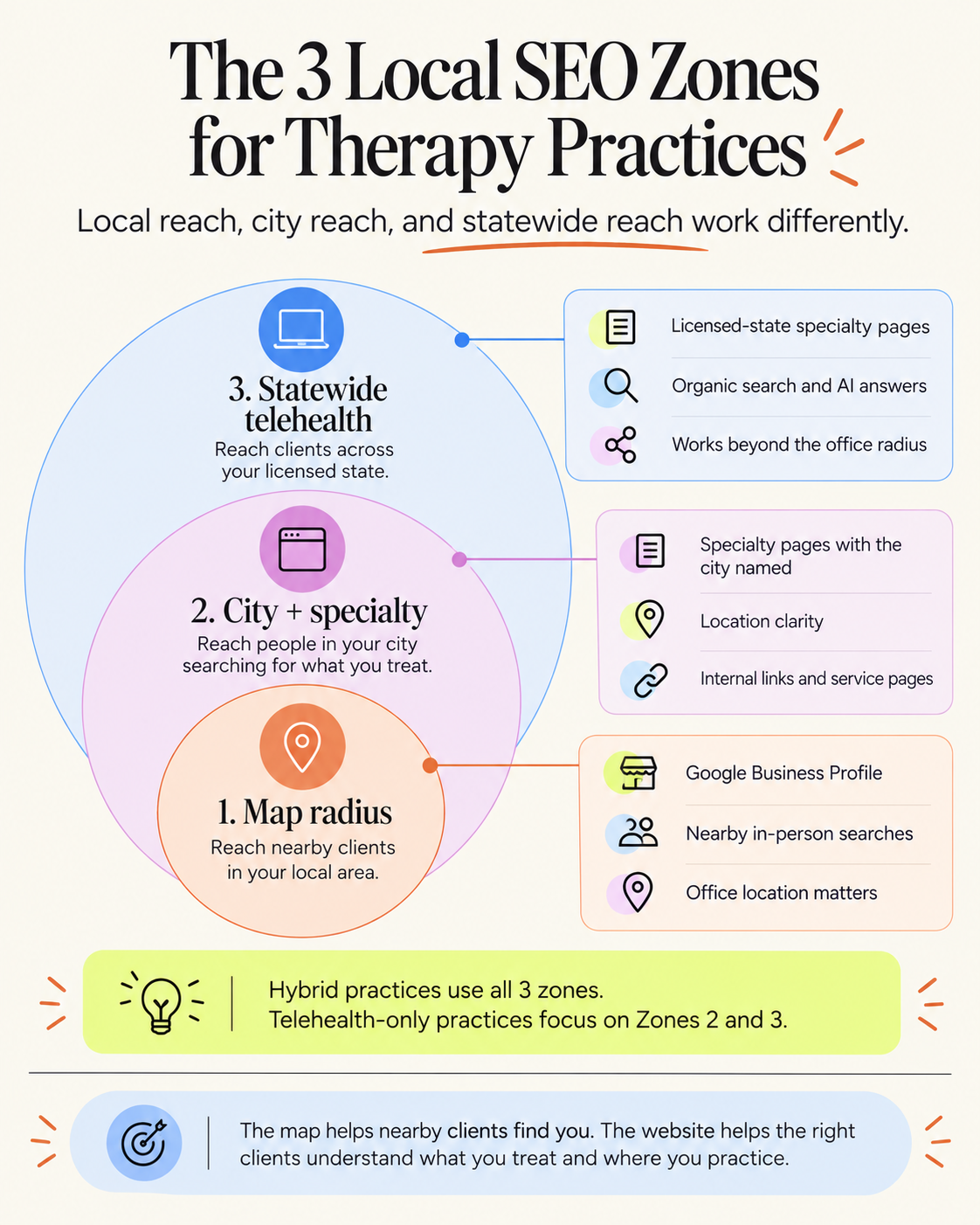
Three local SEO zones: map visibility, city and specialty searches, and statewide telehealth reach.
A hybrid practice has to be clear about the difference between the office and the license. Your office is in Charlotte, and you may be licensed to see clients by video across North Carolina. Those are two different pieces of information and two different kinds of pages, and creating twenty city pages across the state just because the license technically allows it creates the doorway problem again. Build the statewide specialty page once, build the office page once, and let the specialty pages carry the city where the office actually is.
How much should a therapist pay for local SEO, and how long does local SEO take?
A therapist should pay for local SEO based on what the work includes, meaning Google Business Profile setup and cleanup, specialty pages written for the practice, directory consistency, and tracking, and should walk away from anyone promising a top-three Maps position in thirty days, because Google's policies for third-party profile managers prohibit guaranteeing placement. Timelines vary with competition, the website's existing strength, and the city.
Google says profile edits can take up to three days to appear, and a new business can take up to a month to show in search, and website changes take longer depending on indexing, competition, and what changed. In a competitive city, a practice can see profile views and clicks move within a couple of months, while the map position for a broad term takes six months or more, and in a smaller market the specialty pages often move faster than that.
I would rather tell you the range than promise a date. The full breakdown of what SEO costs for a therapy practice and what you get at each level is in my post on SEO cost for therapists, which is where I would start before comparing proposals. For a practice that wants the Google Business Profile set up correctly without doing the work, the done-for-you Google Business Profile Package covers the profile, the categories, the services, and the connection to the website.
Tracking is where local SEO connects to the caseload. Google Business Profile performance shows calls, website clicks, direction requests, and profile views, and Search Console shows clicks, impressions, queries, and pages, with Google recommending trends over single positions. Because rankings depend on distance, check map rankings from several points around the office rather than one, and report the specialty and city pages separately from the statewide pages so you can see which zone is working.
Then add the numbers Google cannot give you, meaning how many consultation requests came in, what they asked for, which office they wanted, whether they were the clients you want, and whether they booked. Traffic tells you the pages are being found, and qualified inquiries tell you the pages are reaching the right person, so the second number is the one that decides whether the work is paying off.
What should a therapist fix first for local SEO?
A therapist should fix local SEO in this order, starting with eligibility and accuracy on the Google Business Profile, then the website's clarity about location and services, then location pages only where they serve a real purpose, then directory consistency, internal links, an ethics check before any review request, legitimate local mentions, and tracking that measures inquiries rather than rankings.
· Confirm the practice is eligible for a Google Business Profile before building anything on the listing.
· Fix the profile's name, primary category, additional categories, address, phone, website link, hours, and services, and add real photos.
· Make the website say where you practice and whether sessions are in person, online, or both, without making anyone hunt for it.
· Write a dedicated page for each specialty in the potential patient's words with the city named.
· Create location pages only for real offices with real differences.
· Clean up the directories and listings that matter, starting with Psychology Today and your association profile.
· Link specialty pages, location pages, and clinician pages to each other.
· Check your ethics code and state board before asking anyone for a review.
· Earn mentions where the practice genuinely belongs, like association directories, local media, and referral partners.
· Track inquiries and bookings alongside profile views and clicks.
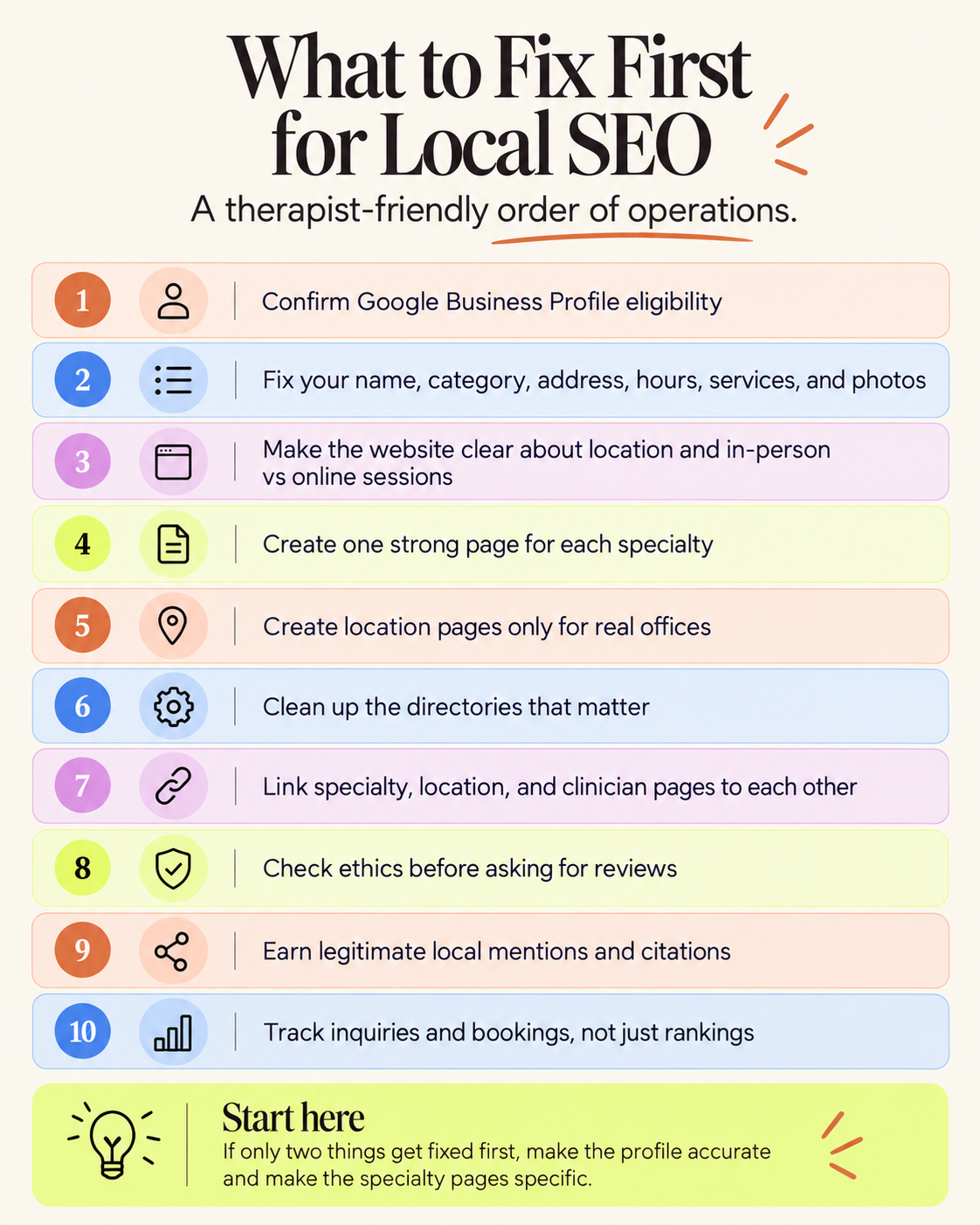
A practical order of operations for reviewing a therapy practice’s local SEO.
If you want to see where your practice sits on each of those before you start, get one of my FREE WEBSITE AND SEO AUDITS, and I will show you what Google is reading about the practice right now.
Local SEO should help potential patients find you without becoming your second job.
You became a therapist, a PMHNP, or a practice owner because you are good at the work, and being excellent at the work is not useful to a person four blocks away who cannot find you. Local SEO matters for that reason, and visibility should not require you to become an unpaid SEO technician on top of running a clinical business. The work at The Passive Practice is built around the practice you actually run, so your ethics, your niche, your office and your license footprint, and your website stay connected instead of being reduced to a checklist written for someone who can collect two hundred reviews. If you want one thing to check today, open your Google Business Profile and count the categories and the photos, because those two numbers are the fastest fix on this page.
Let me know if you have any questions,
Amanda
Frequently Asked Questions
What is local SEO and how does it work?
Local SEO is the work of making a business visible when someone searches for a service near a location. Local SEO works through the Google Business Profile, which drives the map results, and through the website, which drives the organic results underneath, with Google ranking based on relevance to the search, distance from the searcher, and how prominent the business appears online.
What is the difference between SEO and local SEO?
SEO helps a website rank for a topic or question regardless of where the searcher is. Local SEO adds location, so Google matches the searcher's position against the business's address, categories, and the places the website names. A therapy practice usually needs both, with local SEO covering the office's city and general SEO covering statewide telehealth and specialty searches.
Can I do local SEO myself?
Yes. A therapist can set up and complete the Google Business Profile, choose the right categories, add photos, write specialty pages that name the city, and clean up directory listings without hiring anyone. The parts most therapists hand off are the specialty page copy, which needs research into how the potential patient searches, and the ongoing tracking.
How much should I pay for local SEO?
Local SEO pricing for a therapy practice depends on whether the work is a one-time setup of the Google Business Profile and website pages or ongoing monthly work, and on how competitive the city is. Pay for a defined scope, meaning profile setup, specialty pages, directory cleanup, and reporting, and avoid any provider who guarantees a map position, because Google prohibits that promise.
What is the 80/20 rule in SEO?
The 80/20 rule in SEO means that a small share of the work, about 20 percent, produces most of the results. For a therapy practice's local SEO, the 20 percent is a complete and correctly categorized Google Business Profile plus one well-written page for each specialty that names the city, and most of the remaining tasks matter far less until those two are done.
Can a telehealth-only therapist have a Google Business Profile?
Generally, no. Google requires in-person contact with customers during stated business hours to qualify for a Business Profile and lists online-only businesses as ineligible. A telehealth-only therapist builds visibility through specialty pages written for the states where the therapist is licensed, organic search, and the AI tools potential patients use to find a therapist.
APPROVED
AMANDA
PHOTO
About the author
Amanda Smith, MA, MFT & CEO of The Passive Practice. Amanda is a therapist in private practice who built The Passive Practice, a brand strategy and marketing agency for therapists, psychiatric nurse practitioners, physicians, and group practices. Every project starts with three things: a brand voice that sounds like the clinician, an ideal client profile built from real research, and keyword research so the right client can find her, with the website built on top of those. She keeps a caseload on purpose because it keeps her useful to the therapists she works with.