When you started your private practice, the website, intake process, and marketing were built around you, your niche, and the clients you loved working with. Now your caseload is full. You've turned away three people this month who would have been a good fit, and a colleague has said what every busy therapist eventually hears: you should hire another therapist.
Hiring sounds logical, but hiring alone doesn't create a healthy group practice. It creates payroll, management, intake questions, clinician support, marketing needs, documentation standards, and decisions you never had to make when you were the only person in the business. If you're figuring out how to start a group practice, the job posting is not your first step. First, find out whether your demand, numbers, systems, and interest in the owner role are ready for another person to depend on them.
Key Takeaways
· A full founder caseload shows demand for you. A group practice also needs clients who will book with other clinicians, so ask whether the people you turn away would see someone else on the team.
· Before you hire, model collected revenue per session, the full cost of a clinician, and the break-even caseload.
· Employee versus independent contractor status depends on the actual working relationship under federal and state law, not the label in a contract.
· Intake, matching, payroll, scheduling, documentation, and clinical support need to be in place before the first clinician starts.
· Your website and intake process must introduce the whole team. Otherwise, the new clinician may struggle to fill a caseload while every inquiry still asks for you.
When should a therapist start a group practice instead of staying solo?
A therapist should consider a group practice when there is consistent demand the solo practice cannot serve, enough financial room to support another clinician while their caseload grows, and genuine interest in managing people. Compared with solo work, the owner's role expands into hiring, leadership, finance, and operations alongside clinical care.
A full caseload is a signal, not the whole answer. On coaching calls, the question I ask is whether the people you're turning away would see someone else. Are they asking for the kind of clinician you're considering hiring? Would they book with someone other than you? Is demand steady through the year? Are referral partners asking about other openings? A full founder caseload tells you people want to work with you. A group practice needs demand that can move across a team.
The second question is whether you want the owner job, and it's often skipped. You can love being a therapist and dislike managing people. Those things are not in conflict. Owning a group practice means spending more of your week on hiring, finance, operations, staff concerns, capacity planning, and problem-solving. Many owners reduce their own clinical caseload because the business needs that time. It's a change in what you do all day, not a failure of the career you've built. Start a group practice because the business model fits the work and life you want, not because it seems like the next level of private practice.
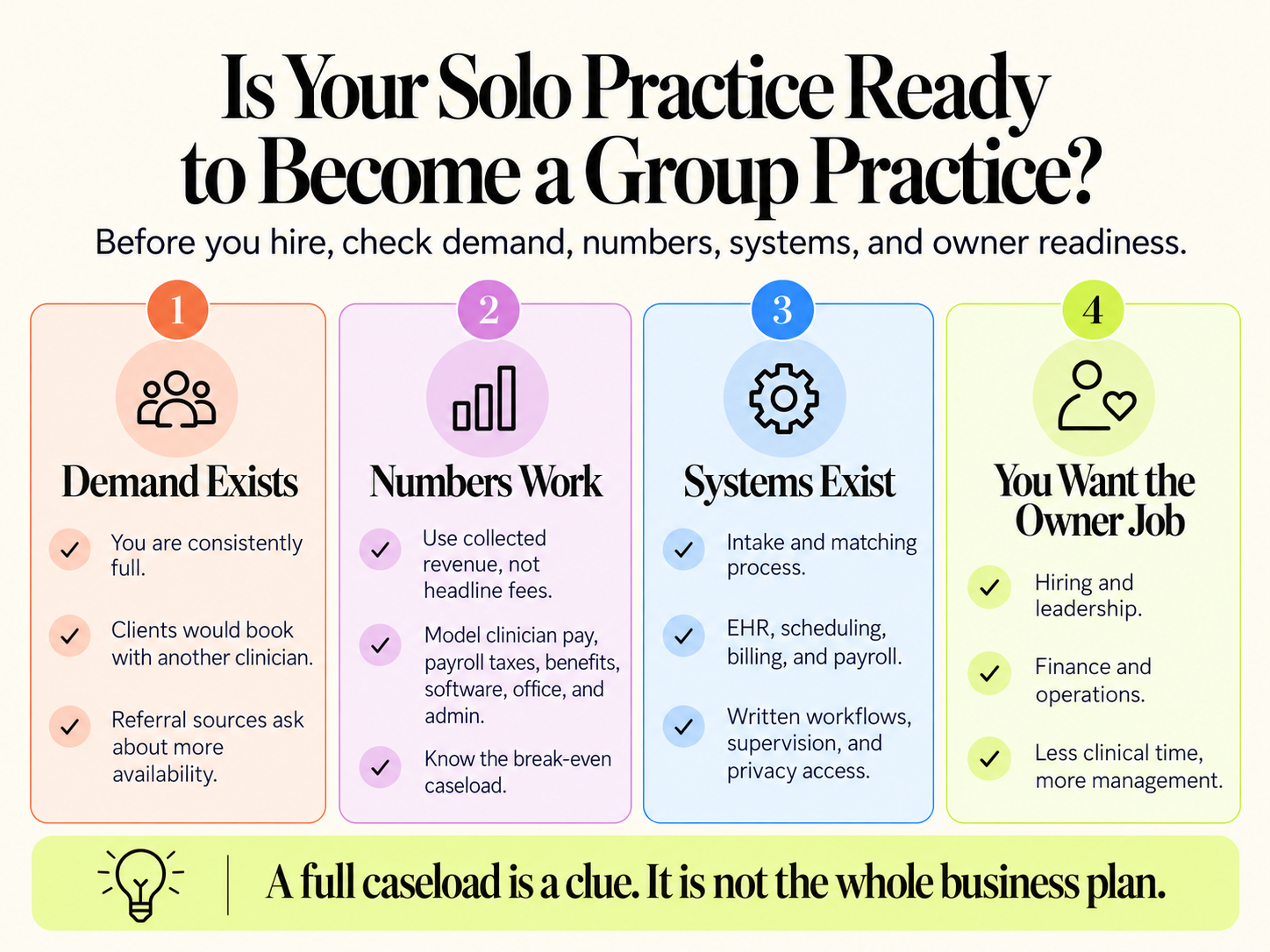
A full caseload is one signal. The four decisions above tell you whether growth is workable.
How do you legally set up a group practice in the US?
To set up a group practice in the United States, choose a business entity permitted for your profession in your state, obtain an Employer Identification Number (EIN), determine whether the organization needs an Entity Type 2 NPI for billing, and plan employee or contractor classification, credentialing, and payroll before a hire begins.
This is educational information, not legal or tax advice. Have a healthcare attorney and a CPA review your business structure, worker classification, and tax setup. Requirements vary by state, and mistakes become the owner's responsibility.
State rules, identifiers, and credentialing
Start with the legal entity. In California, rules for licensed behavioral health professionals and professional corporations are more restrictive than those for ordinary businesses. Review your state's licensing board rules and Secretary of State requirements before paying for formation documents; California's professional corporation provisions are one example. Once the entity is established, you can apply for an EIN. For group practices that need an organizational NPI, CMS identifies group practices as Entity Type 2 providers.
An NPI identifies the practice. It does not prove that a clinician is licensed, credentialed, or approved to bill every insurer you accept. That's why payer enrollment and credentialing timelines belong in your hiring plan, not after the clinician starts.
A business attorney who works with healthcare practices and a CPA who understands group practices are the two professionals I tell every owner to have before the first hire, and I say that as someone who builds the marketing side and has watched the legal side get skipped.
What are the key components of a business plan for a group therapy practice?
A group practice business plan needs collected revenue per session, a realistic caseload per clinician, total clinician cost including applicable payroll taxes and benefits, fixed overhead, a break-even caseload, startup capital, the office or telehealth setup, and a plan to fill the new clinician's schedule.
Start with collected revenue
The SBA recommends estimating startup costs and calculating the break-even point before committing to growth. Its startup cost planning guide is a useful starting point. Work from collected revenue, not the advertised fee. If your fee is $200 but insurance contracts and reduced-fee arrangements mean you usually collect $135, the model uses $135.
Here's a hypothetical example: a clinician completes 18 sessions a week at $140 collected per session over 46 working weeks. That produces $115,920 in annual collected revenue. If, for illustration only, clinician compensation is $70 per completed session, $57,960 goes to the clinician and $57,960 remains before other expenses. That remainder is not profit. The practice still pays applicable employer payroll costs, benefits, EHR access, billing, office space, marketing, supervision, administrative support, insurance, software, and the owner's management time. It also absorbs weeks when the caseload is lighter than projected.
The $70 figure is not a pay benchmark. It simply shows why revenue and profit are different numbers. The model should work on paper before someone else's income depends on it.
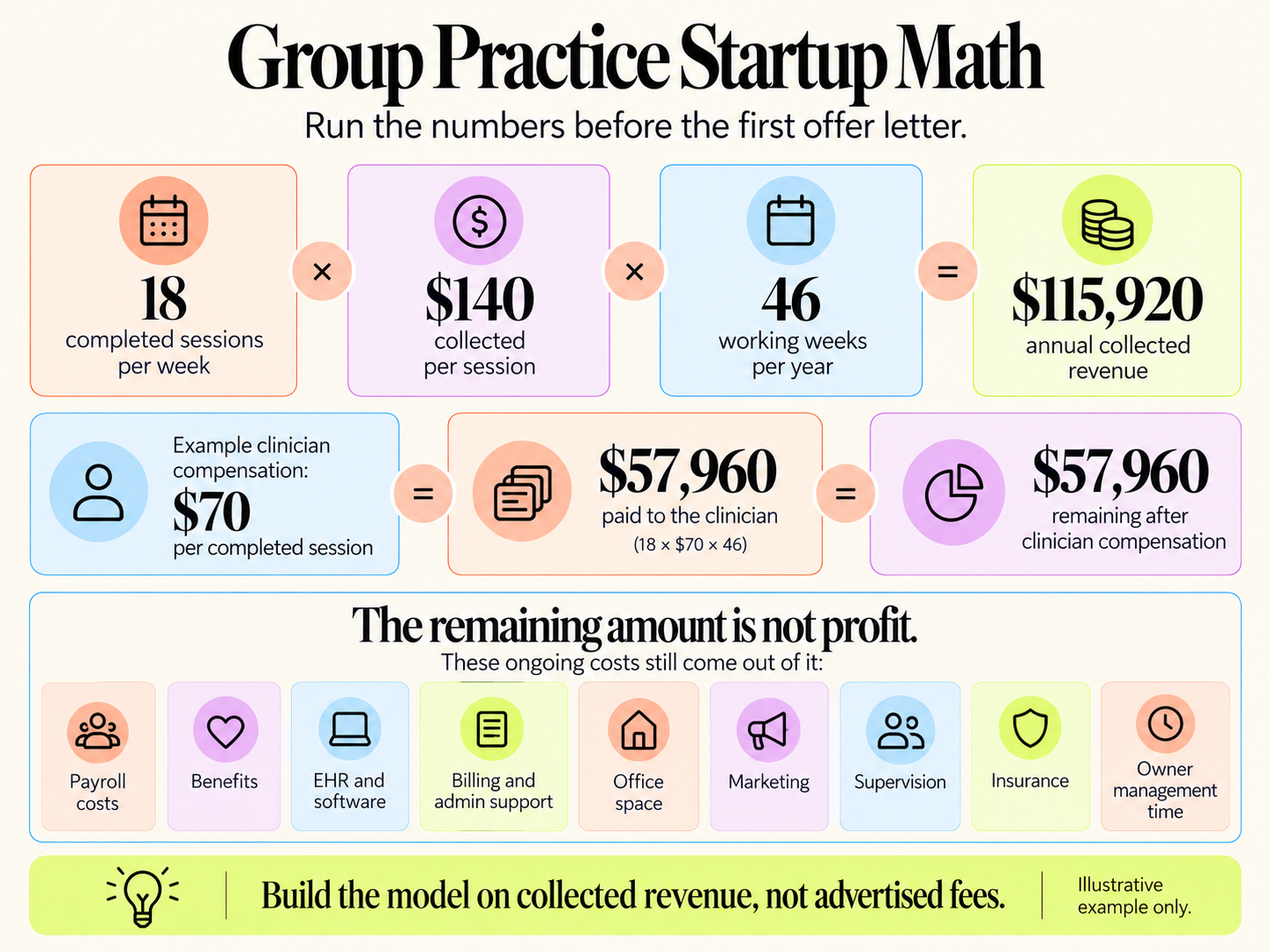
Illustrative numbers only. The remainder after clinician compensation is not profit.
What a 60/40 split actually means
The 60/40 split comes up because a lot of therapists first hear about group practice through that phrase. A 60/40 split generally means the clinician receives 60 percent of collected revenue and the practice retains 40 percent to cover overhead and any profit. But arrangements vary by region, payer mix, license level, and worker classification. A split that works for a cash-pay practice in one market may lose money for an insurance-based practice elsewhere. Build the split from your own costs, not from a number somebody mentioned in a Facebook group.
Budget for the ramp-up and office space
Startup capital and office space are two questions I hear often on coaching calls. Some owners use reserves built while their solo caseload is full; others consider financing or a slower hiring plan. Don't assume the first clinician will reach a full caseload in a fixed number of months. Model a conservative ramp-up and make sure you can fund the gap. A business loan or line of credit may be an option, depending on your circumstances, but it should be evaluated against your forecast and ability to repay.
A full office lease doesn't have to be the first move. Depending on licensing, payer, and local requirements, a hybrid arrangement might pair sublet office time with telehealth while you learn what the new clinician's caseload actually needs.
Should therapists in a group practice be employees or independent contractors?
There is no one-size-fits-all answer for a therapy group practice. For federal tax purposes, the IRS examines the full working relationship, including behavioral control, financial control, and the relationship between the parties. A contract calling someone an independent contractor does not settle the question. State rules may be stricter.
Look at the real working relationship
If you control a clinician's schedule, workflows, client assignment, and the way services are performed, those facts may point toward an employment relationship. But no single detail settles classification, and professional licensing or supervision requirements can affect the analysis. The IRS explains the factors in its worker classification guidance. California and other states can apply additional tests, so don't choose a 1099 model because another practice owner mentioned it at a conference.
Employees typically bring employer payroll obligations and may receive benefits, while properly classified independent contractors operate under a different relationship. The financial and operational trade-offs are real, but incorrect classification can be expensive. Have the specific arrangement reviewed by an employment attorney and a tax professional before sending an offer letter.
Put payroll and benefits into the cost model
If you're hiring employees, payroll needs to exist before they start. The SBA hiring guidance covers tax IDs, employee forms, pay periods, leave policies, payroll administration, recordkeeping, and reporting. In practice, that means knowing who runs payroll, when clinicians are paid, how administrative time is handled, and who fixes a payroll error.
Benefits change the model too. Health insurance, retirement contributions, paid leave, continuing education, and supervision all affect total cost. For eligible small employers, SHOP eligibility rules generally include businesses with 1 to 50 full-time equivalent employees, subject to additional requirements. Run the numbers before promising benefits in an interview.
What systems does a group practice need before the first clinician starts?
Before the first clinician starts, a group practice needs an intake and matching process, multi-clinician scheduling and EHR workflows, written procedures for recurring tasks, appropriate access to client records, a clinical consultation or supervision structure, and a credentialing timeline.
Build intake and clinician matching
As a solo therapist, your memory is part of the operating system. You know which clients are a good match, what to say when someone asks about insurance, and which appointment to offer when an inquiry comes in with a specific problem, and none of that is written down because nobody else needed to know. That stops working when the business involves more than one person. Decide who answers inquiries and how quickly, what information gets collected, how the practice decides which clinician fits, what happens when the requested clinician is full, and how someone moves from inquiry to first appointment. Lead generation does not help a group practice when every inquiry sits in someone's inbox for four days.
Write down the workflows you repeat
Then write down how the practice handles scheduling, cancellations, payments, forms, documentation, billing, time off, coverage, referrals, and discharges. Do not build a giant operations manual nobody reads. Start with the tasks that happen every week, so someone other than you can understand how each one works. For the platform, pick an EHR that handles shared scheduling, multi-clinician billing, and a client portal, because SimplePractice, TherapyNotes, and the other group-ready systems were built for this, and a solo setup with a separate scheduling tool starts breaking at the second clinician.
Set access and privacy rules
Access and privacy require decisions before the new clinician logs in. For covered practices, the HIPAA Security Rule includes administrative, technical, and physical safeguards. Know which systems each person can access, which records they need, who controls permissions, and how access is removed when someone leaves. Shared administrator logins make that harder and undermine accountability.
Create a clinical support structure
Clinical structure matters as much as the software. Before a clinician starts, decide who handles consultation, crisis procedures, documentation concerns, coverage, complaints, mandatory reporting, and supervision. Check the licensing board for that clinician's profession and state. An associate working toward independent licensure can create different supervision obligations from a fully licensed clinician. And if you take insurance, confirm individual and group enrollment, payer effective dates, and contract requirements before promising a full schedule.
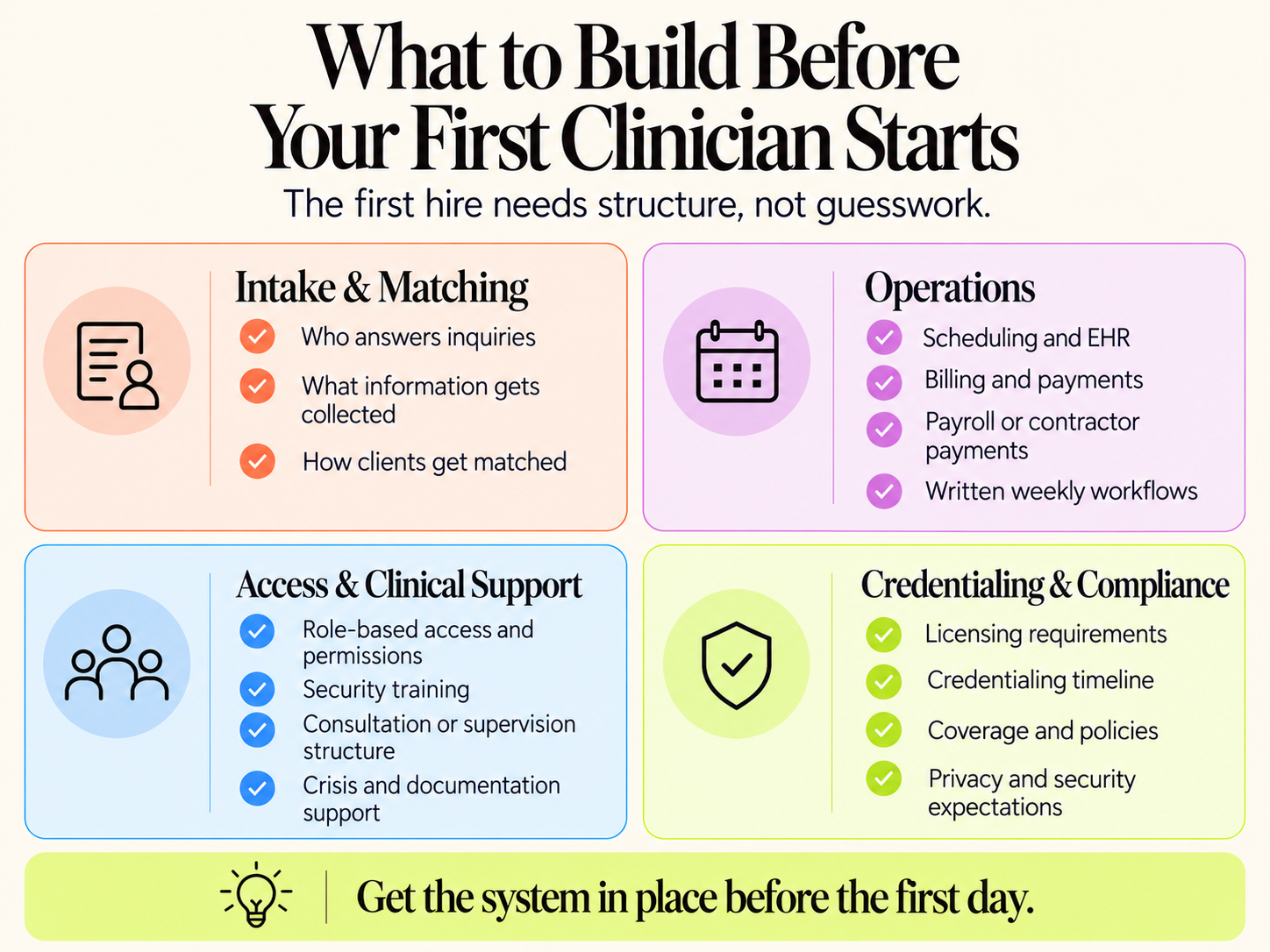
Build intake, operations, access controls, and clinical support before day one.
How do you market a group practice and fill a new clinician's caseload?
Marketing a group practice means adjusting the website and intake experience so a prospective client can find and choose a clinician other than the founder. Give each clinician a helpful bio, connect them to relevant specialty pages, tell referral partners who has openings, and measure where inquiries go. Start before the clinician's first week.
Give the team a place on your website
When you started your practice, the website represented who you were as a clinician, your niche, and the ideal client you served, and that is the website most group practices still have after three therapists have joined. Every inquiry still asks for you by name, and that is not always a clinician problem. The most common mistake I see when I do FREE Website & SEO audits for group practices is that new bios and services were added to a layout built for one person instead of a structure that supports a team, so the website never gave visitors and potential patients a way to understand that other clinicians exist or why one of them might be the better fit.
Help people choose the right clinician
A useful clinician page explains who that therapist helps, the concerns they focus on, how they talk about the work, relevant training, location, telehealth or in-person availability, and the next step to get started. Five bios that all list anxiety, depression, trauma, relationships, and life transitions don't help anyone choose. One clinician may work with burned-out physicians; another with couples after infidelity; another with neurodivergent teens; another with postpartum mental health. That specificity helps a potential patient recognize themselves in the page.
Specialty pages should link to the clinicians who actually offer those services instead of sending everyone back to the founder. A growing practice may need clinician pages, specialty pages, and location pages that the original solo website never required. If the structure no longer fits, my article on therapist website redesign explains how to tell. The custom website services at The Passive Practice can support that transition.
Track where inquiries go
Then track inquiry volume, source, requested service, requested clinician, availability, and booking rate. If one therapist fills quickly while another sits at six sessions a week, the answer isn't always more leads. Often, it's about positioning, matching, and routing the leads already coming in. If you want to know where your website might be losing people before you hire, ask about my Free Website & SEO Audit.
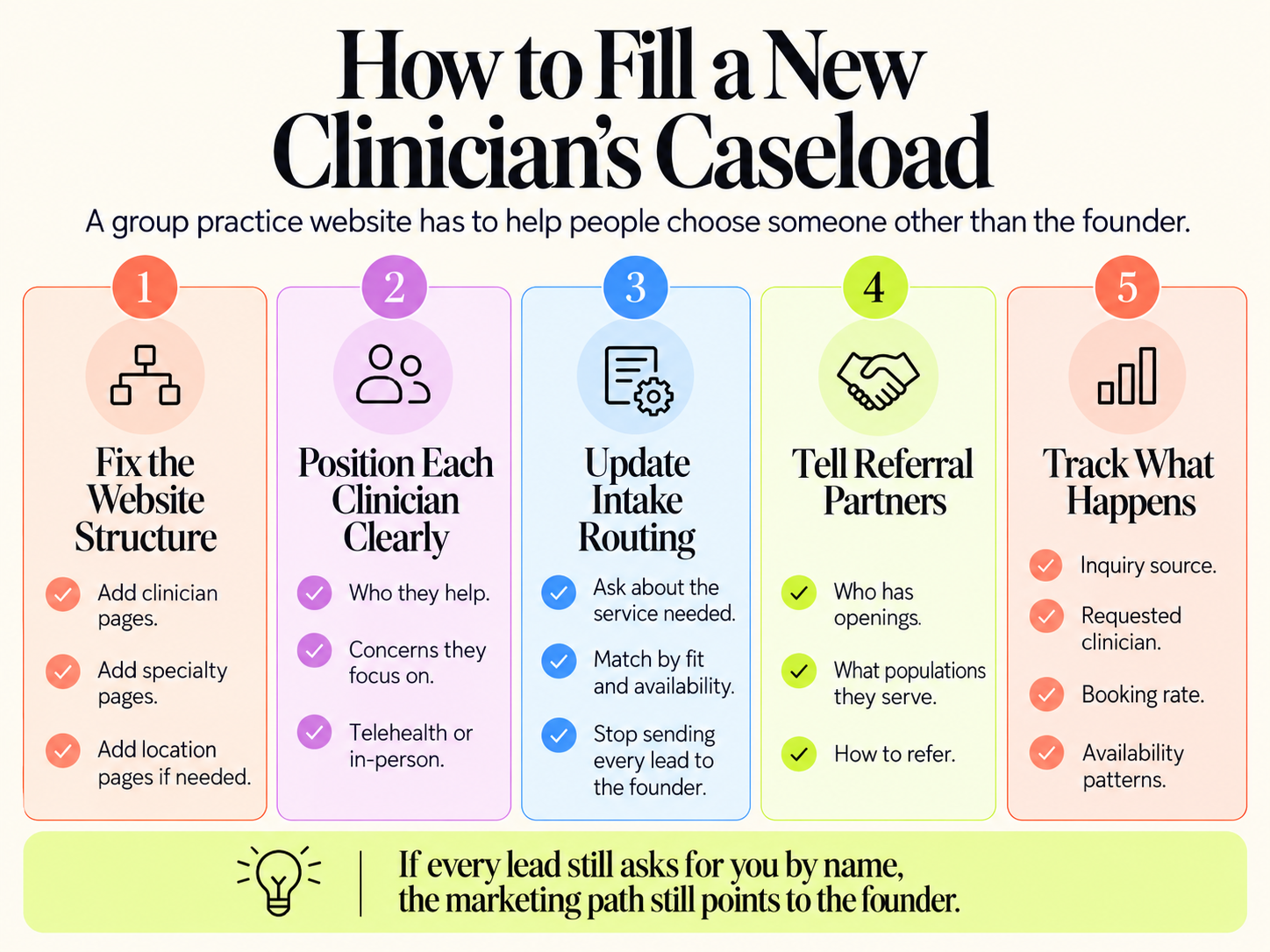
The website needs to help clients choose someone other than the founding clinician.
How does the owner's job change as the group practice grows?
As a group practice grows, the owner's job shifts from delivering therapy to managing clinicians, reviewing numbers, hiring, planning capacity, setting direction, and solving operational problems. The things that made a therapist successful in solo practice are not automatically the things that make the owner of a group practice successful.
Decide which tasks still need you
The question to ask is which parts of the business actually require you, which is a different question from which parts you have always done. You probably do not need to schedule every consultation; you should not be entering payroll, and updating clinician bios is not the best use of your Thursday afternoon. Growth gets easier when the business stops needing the founder for every routine decision.
Sometimes the next hire is not a therapist
Sometimes the next hire is not another therapist. If you already spend hours each week on intake, scheduling, billing follow-up, credentialing paperwork, payroll questions, and administrative email, another clinician makes that worse, and the next hire is intake support, a virtual assistant, a practice manager, a bookkeeper, or an outside payroll service. Adding revenue capacity without adding operational capacity builds a bigger business that feels worse to run. The same applies to hiring pace. One clinician first lets you test the systems at a small scale, and the right number depends on demand, cash reserves, administrative and supervision capacity, referral flow, office space, and your own bandwidth. Hire the capacity the current business can support and build from what the numbers show rather than from the org chart you drew.
What should you be able to answer before hiring your first therapist?
Before hiring the first therapist in a private practice, the owner should be able to answer what role the practice is hiring for, what proves the demand exists, what a realistic caseload generates in collected revenue, what the clinician costs, how classification and payroll will work, what licensing and credentialing apply, how intake and matching run, whether the website is ready for another clinician, and who will manage the new hire.
What role are we hiring for, and what business problem does that role solve?
What proves there is demand that will go to someone other than me?
What is a realistic caseload, and what does that caseload generate in collected revenue?
What does that clinician cost the practice, including payroll taxes and benefits?
Has worker classification been reviewed by an attorney in my state?
Who runs payroll or contractor payments, and when?
What licensing or supervision requirements apply to this clinician?
Does credentialing need to happen, and how long will that take?
Who handles intake, and how are potential patients matched to a clinician?
Are the weekly workflows written down somewhere other than my head?
Is the group practice website ready for another clinician to be found and chosen?
What will fill the clinician's caseload in the first ninety days?
Who manages them, and what will I stop doing after the hire?
If several answers are "I have no idea," that is your planning list, and the list gets done before somebody's paycheck depends on getting the answers right.
How The Passive Practice supports group practice owners
Group practice growth is an area I work on through business coaching for therapists, including the Group Practice & Clinic Growth focus for owners moving into a group or clinic. We work around the owner's actual goals and current problems, because the person struggling with margins and the person whose second clinician isn't filling don't need the same plan.
For one focused decision, the 90-minute strategy session gives you space to work through a particular challenge before committing to ongoing coaching. That might mean hiring, filling a clinician's schedule, or realizing you have a ten-person business whose systems still live entirely in your head.
Starting a group practice should create capacity, not just headcount.
A six-person practice is not automatically healthier than a solo practice. You can have six clinicians and still be the one answering every question, approving every expense, fixing every intake issue, doing the marketing, and worrying every time someone has three openings. Six clinicians and one owner holding every system is a larger team with the same bottleneck. The goal is enough structure, margin, demand, and leadership that the people inside the practice can do good work without the whole operation living in your head, and if that is the business you are trying to build, that is the work I do with practice owners.
Frequently Asked Questions
How to start a group practice?
Start by confirming demand that will go to clinicians other than you. Run the numbers on collected revenue and clinician costs, choose a permitted legal structure, obtain necessary tax and provider identifiers, confirm worker classification with qualified advisers, build the intake and clinical systems, update the website for a team, and start marketing before the new clinician's first week.
What is the difference between a solo practice and a group practice?
In a solo practice, one clinician owns and delivers the clinical work. In a group practice, the owner engages other clinicians, and the owner's role expands into hiring, payroll, supervision where required, intake, marketing, and operations. A group may generate more revenue, but it also carries more overhead and management responsibility.
What is the difference between a private practice and a clinic?
A private practice is a broad term for independent outpatient clinical work and can be solo or group. A clinic may have a more formal organizational structure or multiple service lines, such as therapy, psychiatry, and testing. The terms are used differently across states and settings, so size alone isn't a reliable legal distinction.
What is a 60/40 split in private practice?
A 60/40 split in private practice means the clinician keeps 60 percent of collected revenue for each session and the practice keeps 40 percent to cover overhead, administration, marketing, and profit. Splits vary by region, payer mix, license level, and whether the clinician is an employee or a contractor, so the right split comes from the practice's own cost model.
Should therapists be employees or independent contractors?
There's no universal answer. For federal employment tax purposes, the IRS weighs behavioral control, financial control, and the relationship between the parties. A contract alone does not decide status, and state rules can be stricter. Review the real arrangement with an employment attorney and tax professional in your state.
About the Author
Amanda Smith, MA, MFT, is the founder and CEO of The Passive Practice and a therapist in private practice. She built an agency that pairs brand strategy, website development, and marketing with an understanding of clinical work. Her approach starts with the practitioner's voice, ideal client research, and search strategy, so the finished website reflects the clinician behind it. She continues to see clients, which keeps her close to the day-to-day challenges practice owners face.
Let me know if you have any questions,
Amanda