When you started your private practice email list, you had a plan. Five people downloaded your free guide. Then 40 potential referral sources signed up after a workshop. Over the next few months, the list kept growing.
You sent two newsletters. Each took most of a Sunday. Then your caseload filled up, the emails stopped, and now your platform charges you every month for a list that hasn't heard from you since spring. That invoice comes with a little guilt, doesn't it?
Email marketing for therapists shouldn't become another content job hanging over your week. It works when you know who is on your list, why they joined, which tools are appropriate for the information you're handling, and what people would actually want to receive. Those decisions come before the subject lines and pretty templates.
Key Takeaways
· Therapists can use email marketing. U.S. commercial email requirements and HIPAA privacy rules are separate considerations, and whether HIPAA applies depends on the practice and the information involved.
· Prospective clients, referral partners, workshop attendees, and current clients aren't one interchangeable email audience.
· Keep ordinary marketing systems separate from clinical records. Don't move client lists or protected health information into an email platform without evaluating the applicable rules, vendor agreements, and safeguards.
· A useful newsletter every two to four weeks is a reasonable starting point. Consistency matters more than sending constantly.
· The best email has a reason to exist: a question worth answering, a resource someone requested, an opening they can act on, or an event with an actual date.
Can therapists use email marketing without breaking HIPAA or CAN-SPAM rules?
Yes. Therapists, psychiatric nurse practitioners, and group practices can send educational newsletters, workshop announcements, and practice updates. But two different sets of rules need attention.
The FTC's CAN-SPAM compliance guide explains the requirements for commercial emails, including accurate sender information, nondeceptive subject lines, a valid physical mailing address, and a working opt-out method. It covers promotional messages to other businesses, too. So your referral-partner newsletter isn't automatically exempt just because it's being sent to another professional.
HIPAA asks a different question. The rules apply to covered entities and business associates, and being a licensed therapist doesn't automatically determine whether a practice is a HIPAA-covered entity. More specifically, the HHS marketing guidance addresses when protected health information may be used or disclosed for marketing and when authorization is required.
On consult calls, I explain the practical setup this way: general marketing belongs in a marketing system; clinical communication belongs in an appropriately safeguarded clinical system. Don't routinely sync an EHR contact list into a newsletter platform just because the integration exists. That separation reduces risk, but it isn't a substitute for evaluating the data, the technology, and the laws that apply to your practice.
This article is educational information, not legal advice. Review your setup with the appropriate privacy and legal professionals if patient information could be involved.
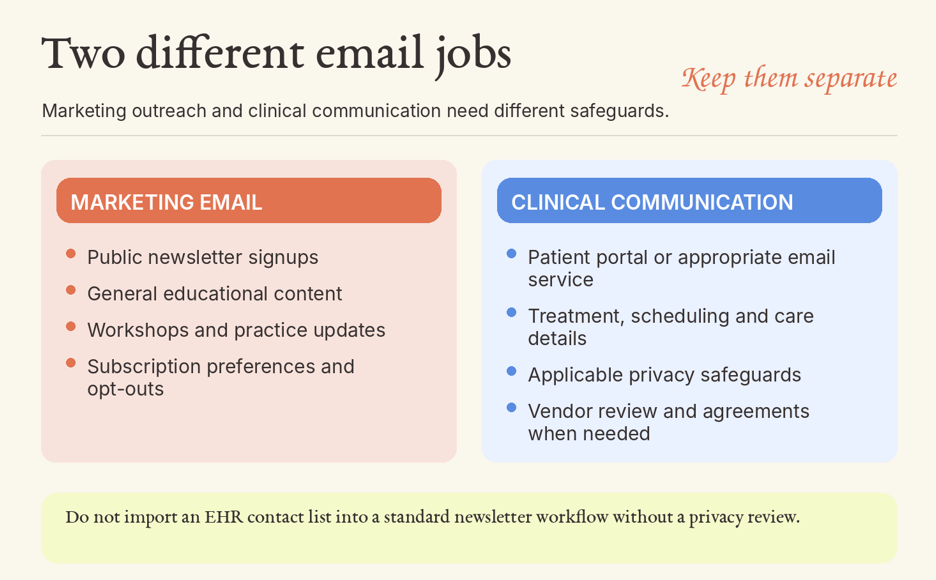
Marketing and clinical communication have different jobs and safeguards.
How do you choose an email marketing platform for a therapy practice?
Choose a platform that does the job you actually need: deliver a resource after signup, run a short welcome sequence, organise people by why they joined, embed forms on your website, and provide a clear way to send someone to the next step.
Flodesk is one platform I'd consider for a public-facing therapist newsletter because its templates, forms, and workflows are designed for straightforward marketing. Mailchimp and Kit are alternatives. The platform you can maintain on a busy Tuesday matters more than a feature comparison that takes three Sundays to finish.
One correction to older Flodesk recommendations: its current pricing is based on active subscriber counts for new customers, not one flat price forever. Check what the plan includes and what it will cost at your expected list size.
The more important question is what data the platform will receive. A person's email address, linked to a treatment relationship or sensitive health context, may be protected information even if you never add a diagnosis field. Don't assume that a generic newsletter platform is suitable for an EHR export, a patient segment, or a clinical automation.
HHS explains that covered providers may email patients for treatment when reasonable safeguards are applied. It also distinguishes vendor access to protected health information from ordinary marketing software use. Before a platform receives PHI, determine whether it is acting as a business associate, whether an appropriate business associate agreement is available, and whether the actual workflow meets applicable requirements.
For practices that have a legitimate reason to email information involving PHI outside the EHR, there are specialised options, including Paubox for private practices. Confirm the current product scope, BAA terms, and safeguards before using any service for clinical information. I would not move patient data into a general email platform without that review.
What about the booking link?
Your scheduling tool and email platform don't have to be the same product. A prospect who is ready to talk should be able to find one clear link to the appropriate consult or booking process. That link might lead to a secure intake or EHR portal. It doesn't require sending client appointments, patient status, or treatment details back to the marketing platform.
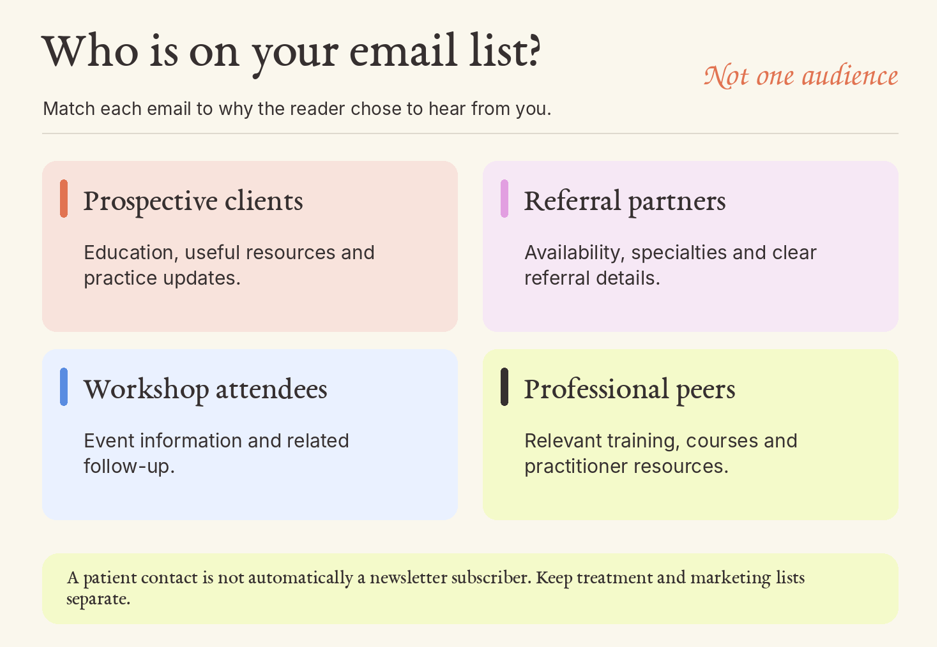
Send readers the information they subscribed to receive.
What should a therapist email list send to prospective clients and referral partners?
A good email gives the reader something useful and makes the next step clear. That's the bar. It can be educational, personal, practical, or time-sensitive, depending on who subscribed.
Educational content. Answer the questions people ask before they reach out. Why does anxiety seem louder at bedtime? What happens when a teenager stops talking? Put some of the answer in the email itself, then link to the relevant blog or service page for anyone who wants to learn more.
A useful resource. Share a short summary of a recent blog, podcast episode, or downloadable guide. Don't make the reader click three times before getting anything helpful.
A glimpse of how you practice. Mention a training, a book, or an experience that changed the way you think about couples, trauma, or the population you serve. This isn't a life story. It's a chance for a potential client to hear the person behind the website.
A practice update. A new clinician has evening openings. A group is forming. A new office has opened. For referral partners, include the specialties, availability, and referral process that would actually help them make a referral.
One next step. Read the related article. Register for the workshop. Request a consult. Download the resource. Please don't make someone choose between four competing buttons.
Courses, professional training, and consulting can belong in the email mix, too, when subscribers have expressed interest. But if every newsletter quietly becomes a sales sequence, people notice. Your redesigned footer probably doesn't need a campaign.
What should therapists never send in a marketing email?
Start with the obvious boundary: an ordinary marketing newsletter isn't the place for client names, appointment records, diagnoses, treatment notes, or stories that could identify someone receiving care. Even seemingly harmless tags or engagement data can create a privacy problem when they reveal patient status or sensitive health interests.
One of the easiest mistakes is using the EHR contact export as the starting point for a newsletter. Those people provided their email addresses for treatment, scheduling, or billing. That doesn't automatically mean they agreed to ongoing marketing. Keep the signup separate and clear about what the person will receive. An ordinary newsletter opt-in, however, does not automatically replace any written HIPAA authorization required for a particular use or disclosure of PHI.
Use sensible judgement with sensitive topics. If you're discussing suicidal thoughts or other crisis-related issues, a short reminder that the email isn't a substitute for care can help, along with a relevant resource such as the 988 Suicide & Crisis Lifeline for people in the United States. That isn't a universal legal requirement for every mental health newsletter, but it can be thoughtful editorial practice when the subject calls for it.
And avoid the high-pressure tactics that already feel strange on a therapy website: alarming subject lines, manufactured urgency, or countdown timers with no actual deadline. Your reader is deciding whether you sound like someone they can trust.
The CAN-SPAM details to get right
For commercial emails covered by U.S. law, the FTC requires accurate header information and subject lines, proper identification of promotional messages, a valid postal address, and a clear opt-out mechanism. The mechanism must remain able to process requests for at least 30 days after an email is sent, and valid opt-out requests must be honoured within 10 business days. You cannot charge an opt-out fee or make people jump through unnecessary steps. The business can also remain responsible when an outside team or platform sends email on its behalf. The FTC's full checklist is worth reviewing before a campaign goes out.
What is the 80/20 rule for email marketing?
The familiar 80/20 rule suggests keeping most emails useful and reserving a smaller share for direct promotion. Think roughly eight helpful emails for every two promotional ones. It's a planning guideline, not a legal requirement or a formula that guarantees bookings.
I don't begin by counting. I ask whether each email gives the person on the list something they can use. Maybe it's an article that answers a question you hear on consult calls. Maybe Thursday evening appointments are now available. Maybe registration for a new group opens next month.
Look back at your last ten emails. If six of them mainly ask people to buy or book and barely explain anything, that tells you something. The problem isn't the number six. It's that the list is turning into a series of requests instead of a relationship.
How often should therapists send marketing emails?
A general newsletter every two to four weeks is a reasonable place to start. A monthly or quarterly referral update may be enough. Welcome emails go out right after signup, while a workshop might justify several messages over a short window.
Starting cadence by email type
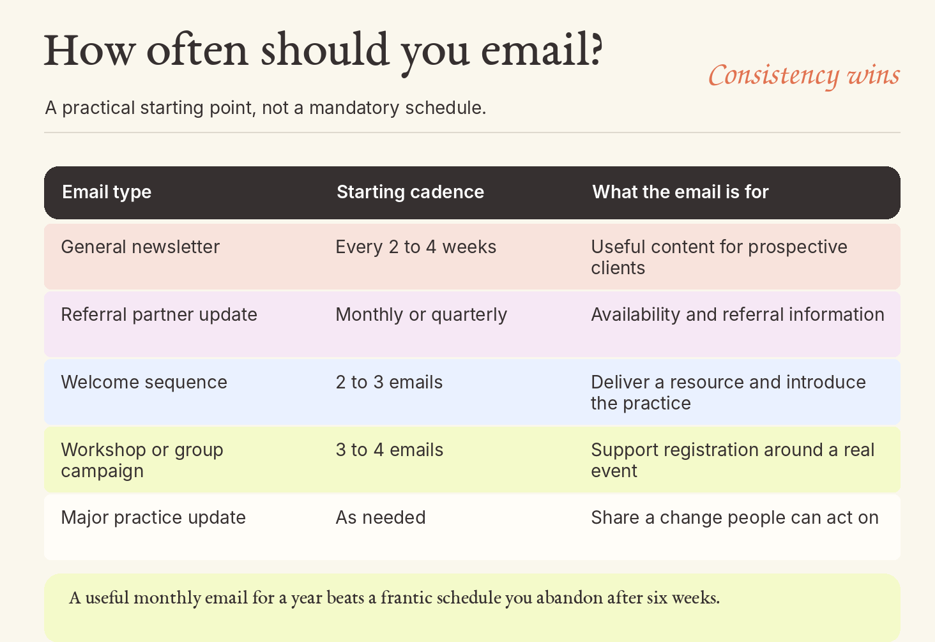
A starting cadence for common therapy practice email campaigns.
The right schedule is the one you can keep while seeing clients. Nobody becomes a better email marketer by pressing Send every Tuesday at exactly eight. A useful monthly email for a year beats two a week for six weeks followed by silence until the next launch.
How do you create an effective email campaign for a therapy practice?
Start with the three-email welcome sequence. You don't need seven messages in five days because someone sold you a funnel template.
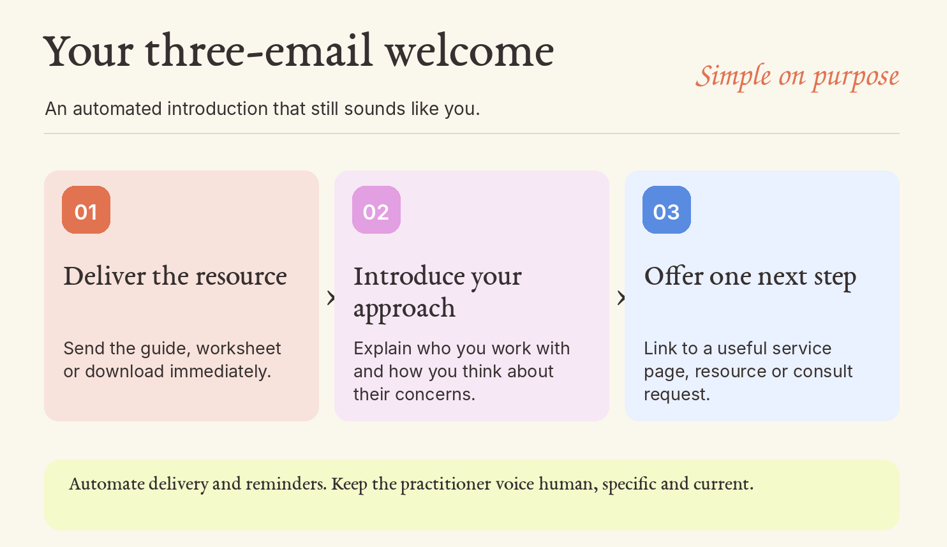
One job for each email in a welcome sequence.
Email 1: Deliver the resource
If someone joined to receive a guide, send it immediately. No three-email introduction before they get what they asked for. That shouldn't be controversial, yet here we are.
Email 2: Introduce your approach
Explain who you help, how you think about the concerns that brought this person to your website, and what working with your practice feels like. Write the way you speak on a consult call, not the way a template says a professional should sound.
Email 3: Give one clear next step
Link to the relevant specialty page, related resource, workshop, or consult request. Don't force the booking. Help the reader work out whether they want to take the next step.
Workshop campaigns follow a similar rhythm: announce the event, answer a real question, send a reminder as the date approaches, and send a final note only when registration is genuinely closing. Every message should have a purpose.
Automate the predictable work, such as resource delivery and timely reminders. Review those sequences, especially after a group fills or an event ends. Twenty-seven automated emails aren't more strategic than three, and a sequence that keeps selling something unavailable is a quick way to lose trust.
Can therapists add current clients to a marketing newsletter?
Don't add current clients automatically just because their contact details are already in the EHR. An address provided for clinical care is not a blanket permission slip for every future marketing email.
For HIPAA-covered practices, HHS explains that uses or disclosures of PHI for marketing generally require an individual's written authorisation unless an exception applies. HHS also distinguishes some treatment, care coordination, and communications about the provider's own health-related services from marketing under its specific definition.
That's why an office-hours notice, a clinically relevant care communication, and a public newsletter can require different handling. A separate newsletter signup gives people a choice, but it does not remove other applicable privacy obligations. Keep patient communications in appropriate systems and evaluate any crossover before building an automation.
What email marketing strategies grow a therapy client base?
Your list grows best when people understand why they're subscribing. Give them a resource relevant to what they came to your website looking for. Put the form on a page where that resource makes sense. Then send what you promised.
Don't try to make one newsletter serve every audience. Prospective clients, referral partners, event attendees, and clinicians interested in professional education joined for different reasons. Segmentation simply means using that distinction to send more relevant messages.
A psychiatrist who refers to you doesn't need the same welcome series as someone downloading a couples guide. You don't need fifty tags to prevent that. You need a small naming system you understand. For the actual setup, see my guide to email marketing tags.
The same goes for getting new subscribers. Put a useful lead magnet beside the content it supports, tell the reader what the signup means, and avoid buying lists or adding attendees to unrelated campaigns without considering what they agreed to receive. The tactical side is covered in email list building.
Measure what happens after the email
For a workshop, count registrations. For an availability update, look at appropriate inquiries and referrals. For a resource, look at clicks and downloads. For a service page, look at relevant consult requests.
Open rates can be misleading because privacy features, including Apple's Mail Privacy Protection, interfere with traditional open tracking. Don't ignore the number, but don't treat it as proof that readers are engaging. Clicks, registrations, useful replies, and qualified inquiries give you a better picture of whether the email served its purpose.
Frequently Asked Questions
What is the 80/20 rule for email marketing?
It's a guideline suggesting that roughly 80 percent of your emails provide useful information and about 20 percent directly promote an offer. For a therapy practice, it's a reminder to help people more often than you sell to them, not a rigid rule.
What is the best HIPAA-compliant email for therapists?
That depends on what you're sending. Clinical information may be appropriate in your EHR's secure portal or another properly configured service with the safeguards and agreements your practice requires. A general newsletter platform shouldn't receive PHI unless its suitability has been fully assessed. No product is automatically compliant just because its marketing says it's secure.
Is there a HIPAA-compliant Gmail option?
Google offers a Business Associate Amendment for certain services under eligible Google Workspace accounts. Accepting the agreement and configuring the services correctly is part of the work, not an automatic guarantee of compliance. Review Google Workspace's HIPAA guidance and the BAA acceptance instructions before using Workspace to handle PHI. A personal Gmail account is not covered by that Workspace BAA.
Do marketing emails need an unsubscribe link?
Commercial emails covered by CAN-SPAM need a clear way to opt out. The FTC says valid requests must be honoured within ten business days and the mechanism must work for at least 30 days after sending. Read the FTC compliance requirements rather than relying only on your platform's default footer.
What is a good email address for a therapist?
A practice-domain address, such as hello@yourpracticename.com, is easy for people to recognise and keeps your professional communications separate from a personal account. If PHI is involved, the domain name alone doesn't determine whether the underlying service is suitable; its configuration, safeguards, and agreements matter.
Your email list is a relationship with people who chose to hear from you
You don't need to email three times a week to remind people the practice exists. And you don't need to disappear for eight months, then return with a dramatic announcement. Keep a rhythm you can maintain, share something useful, and make it easy for people to leave when they're done.
If you do one thing today, open the signup form on your website and read it as a prospective client. Does it say what she's joining and what she'll receive? If not, start there.
If you'd rather begin with a closer look at the website itself, ask about my Free Website & SEO Audit.
Let me know if you have any questions,
Amanda